
Armen Rustamyan: PACE Has Its Own Priorities, and They Fully Align With Supporting Armenia’s Current Authorities
28 January 2026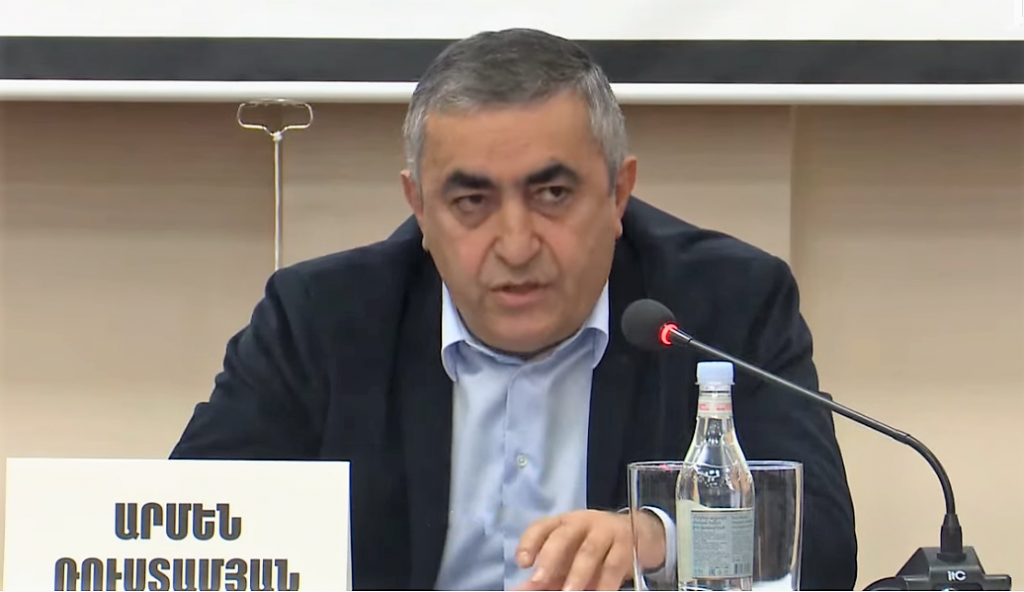
If the resolution adopted in Strasbourg by the Parliamentary Assembly of the Council of Europe (PACE), titled “Progress in the Assembly’s Monitoring Procedure,” is considered a failure of the opposition, then one must also consider it a failure of the opposition that the West fully supports the current authorities in Armenia. I believe this is not news to anyone.
This was stated by Armen Rustamyan, ARF Bureau representative and a member of the “Armenia” faction of the National Assembly delegation of Armenia to PACE, in an interview with Pastinfo, responding to criticism that the resolution adopted the previous day represents a setback for the opposition wing of the delegation.
“In this environment, where this institution has taken a political stance, it is pursuing an entirely anti-Russian course. This is their main priority. Anyone who has followed the sessions of the Council of Europe can see that anti-Russian sentiment occupies a central place there. And Armenia’s current authorities take advantage of this by presenting themselves as bearers of so-called European values, while in reality we all know what is happening in the country.
We are dissatisfied with the wording of the resolution, first and foremost because prior to presenting the report, it was required that a visit by the monitoring co-rapporteurs to Armenia take place. However, that visit was canceled for unclear and unacceptable reasons. The visit could have been postponed, as the reason given was the illness of one of the co-rapporteurs—one of them had been hospitalized. That individual has since been discharged, yet the visit still did not take place.
We have conveyed our dissatisfaction regarding this. We were forced to hold separate meetings with the monitoring co-rapporteurs and fully brief them on what is happening in Armenia. They are well aware of everything—the existence of political prisoners, the persecution and campaign against the Church—and they knew all of this very well. But, as I said, their priority is their political position: to support the current authorities at all costs. This is neither a secret nor anything new.”
Rustamyan noted that against this backdrop, the resolution also attempts in certain statements to emphasize the existence of an unclear tension between the prime minister and the leadership of the Church. “At the same time, it speaks about the misuse of administrative resources ahead of elections and other issues. These are, so to speak, the other ‘face’ of the resolution, and one can see that they correspond to reality.
The rest, in general, stems from their political position—namely, that the West provides unconditional support to the current authorities for well-known reasons.”
He emphasized that perhaps the most troubling aspect is that they refer to reports concerning the campaign against the Church and express concern over them, whereas instead of relying on reports, they could have come under the mandate of the Council of Europe, seen everything on the ground, and fully assessed the situation with their own eyes, rather than being guided by secondhand information.
“They simply do not want to come and see what is actually happening on the ground. This is the most unacceptable aspect of all this. Nevertheless, there are still formulations in the report regarding the campaign against the Church,” he said, stressing that he is not satisfied with the report and that it could have delivered much harsher assessments of the situation in Armenia.
Rustamyan emphasized that members of the delegation continue to meet with the monitoring co-rapporteurs and express their concerns regarding the resolution. “We will try to push them to be at least adequate—to listen not only to the ruling team and not to rely solely on their narratives, but also to take into account the opposition’s views. After all, they have an office in Armenia; let them go and examine these farcical trials themselves. In other words, there is much to say to them, because an institution that seeks to uphold democracy and protect human rights cannot operate in this manner,” he said, emphasizing that this situation does not befit or align with the credibility of such a body.