Second “Armenian Students for Artsakh” Research Competition Successfully Concludes
26 February 2026 On February 18, 2026, in Yerevan, the final event of the 2025–2026 (Second Cycle) “Armenian Students for Artsakh” research competition took place.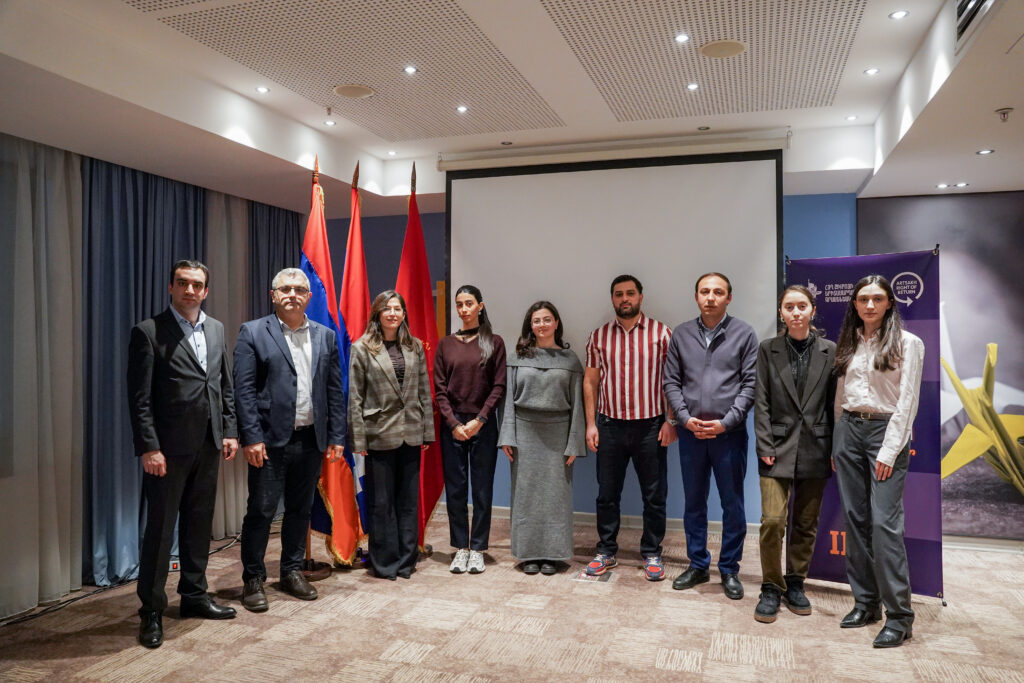
On February 18, 2026, in Yerevan, the final event of the 2025–2026 (Second Cycle) “Armenian Students for Artsakh” research competition took place.
Present at the event were members of the National Assemblies of the Republic of Armenia and the Republic of Artsakh, representatives of the ARF Bureau, the ARF Supreme Body of Armenia, the ARF Central Committee of Artsakh, and the ARF Yerevan City Committee, as well as participating students and advisors, and members of the ARF Student and Youth Associations of Armenia and Artsakh.
This year’s program was sponsored by the Committee for the Protection of the Fundamental Rights of the People of Artsakh, authorized by the National Assembly of the Republic of Artsakh. The central theme of the competition was the Right of Return of the Armenians of Artsakh.
The event was moderated and opened by Tatev Ter-Martirosian, a member of the ARF Western U.S. Central Committee, who presented the importance and objective of the program: “to bring together the professional potential of Armenian students and channel it toward the Armenian Cause in general, and the Artsakh issue in particular.”
Speaking on behalf of the organizers, Tsoghig Ashekian emphasized the important contribution of Armenian students throughout the history of the Armenian Revolutionary Federation, describing them as a vital force that both sustains the organization and generates necessary change.
She outlined the five subtopics of the research theme:
• International Law and Practice – Developing positions grounded in international law that support efforts to secure the return of the Armenians of Artsakh.
• Conditions for Return – Under what conditions can return be considered genuine, complete, and sustainable?
• Roles and Responsibilities – The obligations of Artsakh’s authorities, the Armenian state, and international actors regarding the return of Artsakh Armenians.
• Preserving the Armenian Identity of Artsakh – How to protect tangible and intangible cultural heritage within the framework of return.
• Azerbaijan’s Position and Possible Responses – The major obstacles and strategic responses related to implementing the right of return.
Ashekian also expressed gratitude to the expert advisors from Armenia and the Armenian diaspora who contributed their time and expertise to the program, and thanked the participating students for their dedication and persistence.
The competition included 13 individual students and two student groups from Armenia, Artsakh, the United States, Iran, Syria, Russia, France, Georgia, and Turkey.
During the event, the top five winners shared their experiences, some speaking in person while others delivered messages via video.
Attendees also heard remarks from advisors who had worked closely with the students.
First Prize
The first prize was awarded to Stella Pashian from the United States, a second-year Political Science student at the University of Illinois at Chicago.
Her research was titled:
“The Right of Return: The Indigenous People of Nagorno-Karabakh – The Armenians of Artsakh.”
Her advisor was Dr. Kevork Hagopjian, an attorney, international law specialist, and board member of the Armenian Legal Center.
In his video message, Dr. Hagopjian highlighted the strategic importance of the program and its role in keeping the Artsakh issue on the agenda. He noted that through Armenian students, scholarship and public discourse related to Artsakh can continue to grow through modern research.
Second Prize
Second prizes were awarded to Liana Pohanyan from France and Sofia Aydinyan from Russia.
Liana is a first-year Political Science student at Sciences Po Paris. Her research focused on:
“What Prevents the Implementation of the Right of Return for Displaced Persons from Artsakh Despite International Legal Guarantees?”
Her advisor was Dr. Philippe Raffi Kalfayan, an international law expert, legal consultant, researcher, and lecturer at Panthéon-Assas University in Paris.
Sofia studies at the Moscow State Institute of International Relations (MGIMO). Her research examined:
“A Comparative Analysis of Precedents for the Implementation of the Right of Return of Forcibly Displaced Persons and Lessons Applicable to the Armenians of Artsakh.”
Her advisor was Garnik Gergonian, an international law specialist.
In his remarks, Dr. Kalfayan stated that international law is often violated in today’s global environment where economic and military power frequently outweigh legal principles. However, he emphasized that law will ultimately prevail, and the analyses prepared through this competition contribute to the development of strategic thinking related to the Armenian Cause and the rights of the Armenians of Artsakh.
Gergonian noted that while individuals do not choose their role in history, Armenians have a responsibility to work toward justice and the success of their national cause.
Third Prize
Third prizes were awarded to sisters Vika and Erika Kafyan from Armenia (team submission) and Tigran Arakelyan from Georgia.
Vika and Erika are students at the Armenian State University of Economics. Their research focused on:
“The Importance and Practical Possibilities of Preserving Artsakh’s Historical and Cultural Heritage within the Framework of the Right of Return.”
Their advisor was Lernik Hovhannisyan, former Minister of Culture, Youth Affairs, and Tourism of the Republic of Artsakh.
Tigran Arakelyan, a student of International Relations at Yerevan State University, researched:
“International Preconditions Necessary for the Realization of the Right of Return of the Armenians of Artsakh.”
His advisor was Dr. Gevorg Ghukasyan, program director at the Armenian National Committee Central Office.
Hovhannisyan remarked that in the current circumstances even speaking about Artsakh has become an act of courage. He welcomed the continued participation of the younger generation in the program and emphasized that sustained effort can make the right of return and the protection of cultural heritage a reality.
Dr. Ghukasyan added that such initiatives help clarify the international legal basis of Armenian rights and demonstrate that the right of return for the Armenians of Artsakh is supported by numerous international documents and positions.
Jury
The competition’s jury members were:
• Shahan Kandaharian, Editor-in-Chief of the Beirut newspaper Aztag
• Dr. Gevorg Ghukasyan, Armenian National Committee Central Office
• Gegham Stepanyan, Human Rights Defender of the Republic of Artsakh
Stepanyan emphasized that when Armenian authorities fail to raise the issue of the rights of the Armenians of Artsakh, that responsibility must be taken up by Armenian students, scholars, activists, and journalists in Armenia and throughout the diaspora. He also noted the symbolic significance that the first prize winners represented the United States, France, and Russia — countries that served as co-chairs of the OSCE Minsk Group.
Remarks by Artsakh Representatives
Students were also addressed by Vahram Balayan, Chairman of the Standing Committee on Foreign Relations of the National Assembly of the Republic of Artsakh. He stressed the need to keep the Artsakh issue present in international discussions and encouraged continued research on the topic.
Closing Remarks
Closing the event, Hovsep Der Kevorkian, member of the ARF Bureau responsible for youth affairs, congratulated the students and thanked the advisors. He highlighted three key guiding principles:
-
Faith, especially in difficult times when efforts are made to weaken Armenian confidence.
-
Planning and implementing concrete actions.
-
Maintaining the spirit of struggle through full commitment and dedication.
At the end of the event, all participating students received copies of the book “Proceedings of the Conference on Artsakh, 2024,” published by the Catholicosate of the Great House of Cilicia.
The next stage of the program will focus on making the research available to institutions engaged in pro-Armenian advocacy and policy work. Efforts will also be made to publish the studies in academic or professional publications to make them accessible to a wider audience.
Through this initiative, the organizers reaffirmed their commitment to continuing the program and encouraging Armenian students to contribute to Armenian causes, particularly efforts aimed at securing the right of return and self-determination of the Armenians of Artsakh.
February 18, 2026
Yerevan
For the full photo gallery from the event, visit:
https://www.facebook.com/share/p/1C6ywzzbTt/