The Situation Calls for the Urgent Alignment of Armenia–Diaspora Political Agenda
02 April 2026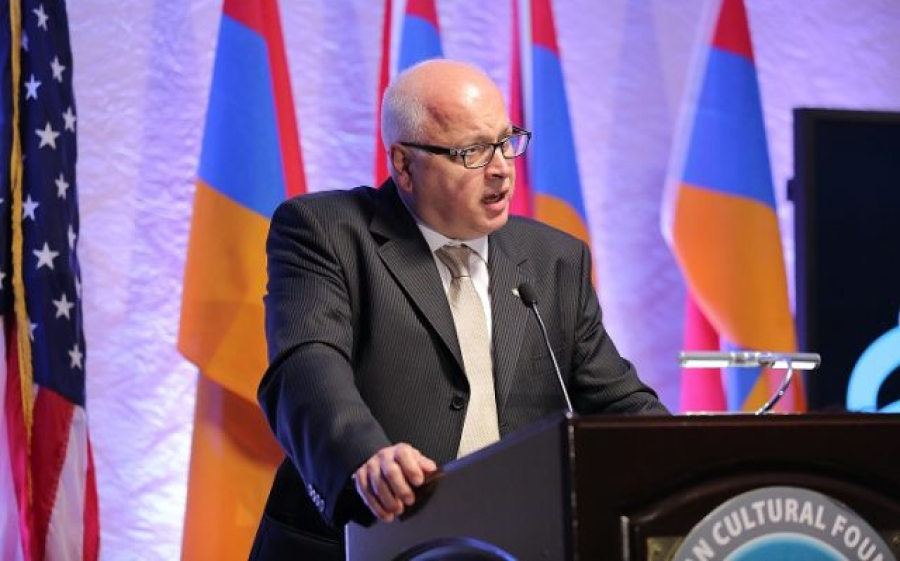
EDITOR’S NOTE: During the Armenian Revolutionary Federation Western U.S. Diaspora Conference on March 14 and 15, Armenian Revolutionary Federation Bureau member Daron Der-Khachadourian made a presentation outlining the urgent imperatives for the Diaspora and Homeland.
Below is the English translation of Der-Khachadourian’s presentation, which was made in Armenian at the conference.
The Armenian Diaspora, defined as a population established outside its homeland, has a history of 1,600 years. Over the past millennium, being at the crossroads of three major empires—Ottoman, Russian, and Persian—the Armenian people have suffered greatly through displacement and continuous outflow from their ancestral lands.
In the past century, three major events created a fundamentally new reality in the concept of the Armenian Diaspora: the Armenian Genocide and its severe consequences, the dual independence of the Republic of Armenia, and the depopulation of Artsakh.
These three large-scale developments were, first and foremost, major political turning points for Armenians, creating new types of conditions and reshaping the Armenian landscape—whether in Armenia itself, in the “new Diaspora” (post-Soviet communities), or in the traditional post-Genocide Diaspora. These events significantly affected the geographic, socio- political, relational, and organizational fabric and spheres of the Diaspora’s activity. In short, the entire landscape and context have changed.
The last comparable upheaval of this magnitude—though not equal in scale—was Shah Abbas’s forced relocation of Armenians to Persia 400 years ago.
Thus, politically, not only the Diaspora, but the Armenian nation as a whole, now finds itself in an entirely new kind and scale of reality—with a reduced Armenia in size and population, and a globally dispersed people.
Much has been written about the transformation of post-Genocide Diaspora communities, and I will not dwell on that today. My focus will instead be on overcoming the current critical situation that requires the strengthening Armenia–Diaspora dynamics, and harmonizing policy around this theme.
Therefore, given that:
- The Republic of Armenia today is the only state remaining in Armenian hands on its ancestral lands;
- Around 250,000 Western Armenians found refuge in Armenia after the Genocide;
- Within the framework of nation-state development over the past two centuries, Armenia today is the only functioning Armenian state, with full sovereignty, representation, and membership in international structures;
- The concept of “one nation, one homeland” is not merely a slogan;
- More than 1.4 million Armenians have left Armenia since its independence;
- Armenia today is the natural refuge for the Armenians of Artsakh;
- The 1918 Republic of Armenia was itself the result of the combined efforts of Eastern Armenians, Western Armenians, and the Diaspora—and serves as the birth certificate for today’s Republic;
- As a result of centuries of Armenian national liberation struggles (16th–20th centuries), a Republic of Armenia—even if small—exists today.
Thus Armenia and the Diaspora have both the obligation and the earned right to develop their political dynamics constructively and to pursue aligned policies. Therefore, the concept of “one nation, one homeland” is not merely ideological or subjective—it is a logical and an objective framework.
Certainly, one can cite legal or pragmatic reasons to avoid such coordination and alignment. However, doing so would amount to hiding behind excuses to avoid necessary action.
Especially for Armenians, it was through collective injustice that we became a Diaspora. Few nations—if any—face such a stark duality: building an independent state on one hand, while simultaneously confronting a disorganized and expanding new Diaspora.
Thus, the interests of Armenia and the Armenian people are not conflicting, but rather are complementary to one another. In many cases, one serves the other, with the Diaspora often acting as a reserve force, base of resource and a capacity pool for Armenia. Their relationship is not unequal, but mutually reinforcing—synergistic and symbiotic.
Sensitive issues can be resolved through reason and alignment. What is ultimately required is goodwill—not competiveness—and resolve.
After the independence, some efforts were made in this direction. However, the past eight years have created a deeply concerning situation. In many cases, the Armenian authorities have taken positions contrary to the established Diaspora institutions—whether political, lobbying, social-educational, diplomatic, or organizational. Shifting the burden of Genocide recognition onto the Diaspora, sidelining the Artsakh issue, dissolving the Ministry of Diaspora, fragmenting pan-Armenian structures, and reducing Armenia–Diaspora relations to a narrow circle of individuals have contributed to overall stagnation.
In response, the Diaspora today feels disoriented and partially lost, searching for a new paradigm—often turning inward and adopting defensive approaches, sometimes echoing sentiments like “we’ve given enough to Armenia and Artsakh; now it’s time to focus on ourselves.”
What is needed, therefore, is a clear division of roles—accountability, responsibility, consultation, and transparency—through which Armenia and the organized Diaspora jointly can develop strategies, tactics, and measurable programs in the following areas:
- Strengthening Armenia’s independence and sovereignty, with full Diaspora involvement—political, diplomatic, military-industrial, and beyond;
- Coordinating efforts on Genocide recognition and reparations, and organizing steps toward the collective and secure return of Artsakh Armenians;
- Aligning actions regarding vulnerable Diaspora communities;
- Expanding efforts in education, identity preservation, and cultural continuity—where possibilities are limitless, requiring forward- leaning policies;
- Supporting Western Armenian, which is in decline, where Armenia has accessible capabilities;
- Developing and implementing policy in economic cooperation, entrepreneurship, and other sectors.
Allow me to offer some thoughts about focusing on the Diaspora itself: without a healthy Armenia–Diaspora relationship, Armenia will suffer on one hand, while on the other hand, the Diaspora will fade. The purpose of the Diaspora is not merely the survival of Armenians—it gains meaning by strengthening Armenia and reclaiming national rights. Otherwise, a purely inward-looking Diaspora will gradually diminish.
Thus, it is both possible and desirable to strengthen and politicize the Diaspora, and to guide it with clear leadership—without isolating ourselves. Strengthening the Diaspora does not mean weakening Armenia. This is not a zero-sum game.
Finally, a note on Armenians who emigrated from Armenia—the so-called labor migrants. Much of the above focused on the post-Genocide Diaspora. This group, largely driven by economic motives, represents a distinct subculture with different challenges and opportunities.
Armenia—and even the traditional Diaspora—must develop an agenda for engaging this group, despite the complexities surrounding identity preservation among those who left voluntarily in pursuit of prosperity and foreign citizenship. Over time, however, distinctions between these groups are likely to diminish.
Thank you.