Editorial: The Imperative of Diaspora Reorganization and Mobilization
02 September 2026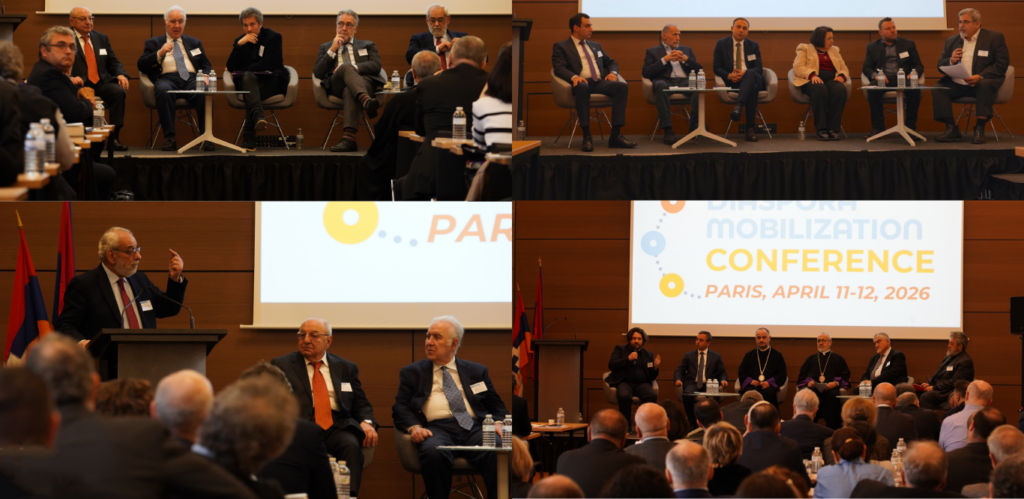
The launch of the new website for the Conference on the National Mobilization of the Diaspora, held in Paris in April, and the publication there of summaries of the conference’s four roundtable discussions offer a timely opportunity not only to revisit the ideas expressed there, but also to begin a broader, deeper, and more sustained discussion about the Diaspora’s future political, institutional, and strategic role.
In this sense, the conference was a timely and valuable initiative. It brought together, on a single platform, people with different experiences, areas of expertise, and worldviews to address questions that have often been examined separately, partially, or sporadically. The reorganization of the Diaspora, Armenia-Diaspora relations, questions of identity, political responsibility, and long-term national strategy were considered here as interconnected challenges. This in itself is an important achievement. Yet the true value of such an initiative will be measured not only by the quality of its discussions, but also by what follows from them.
The Diaspora’s principal problem today is not a lack of resources, talent, or potential. Its main challenge is the absence of sufficient mechanisms capable of transforming dispersed potential into a consistent and organized force. Schools, churches, cultural institutions, political and legal advocacy, professional networks, economic capacity, and youth engagement are not separate fields. Together, they form the infrastructure of Armenian collective strength.
Within this framework, the question of the Diaspora’s autonomy is fundamental. An autonomous Diaspora does not mean a Diaspora detached from Armenia or indifferent toward the Armenian state. On the contrary, a Diaspora capable of forming its own positions, defining its own priorities, and acting independently can be one of Armenia’s greatest strategic assets. Loyalty to Armenian statehood does not mean subordination to the government of the day, nor should the Diaspora’s positions be dictated by the fluctuations of Armenia’s domestic politics. Governments change; national interests, historical responsibilities, and long-term questions often do not.
Artsakh is one of the clearest tests of this distinction. The right of return, the status of Armenian prisoners, cultural heritage, property rights, and international accountability cannot disappear from the pan-Armenian agenda simply because one day they may become less prominent in Armenia’s official diplomacy.
The preservation of identity is equally strategic. Language, education, historical memory, culture, and institutional life are matters of national security. In this regard, the Armenian Apostolic Church continues to remain one of the central pillars of Diasporan identity and organized community life.
Autonomy, however, must not be confused with fragmentation. The Diaspora’s strength lies in its ability to be at once autonomous, interconnected, and capable of acting collectively. This also raises the unresolved question of political representation: Who speaks on behalf of the Diaspora? With what legitimacy? And what new consultative or representative structures are needed?
The task, therefore, is not to restore the old Armenia-Diaspora relationship, but to create a new 21st-century partnership based on mutual respect, participation, autonomy, and shared responsibility. Such a partnership is possible only between strong sides guided by national values. A Diaspora that lacks independent thinking is not a partner; it is an auxiliary structure.
Armenians have never lacked conferences, declarations, or diagnoses. The question now is simple: What comes after the discussion? International legal and diplomatic networks, new educational initiatives, sustainable funding mechanisms, professional mobilization, and representative structures deserve serious examination precisely because they attempt to answer that question.
Ultimately, the measure of every strategy is the new generation. If young people do not have access to language, knowledge, responsibility, opportunities for leadership, and a genuine sphere for political participation, then all other programs are temporary.
The newly published summaries, therefore, should not be regarded as the concluding stage of the conference. On the contrary, they should serve as the beginning of a more demanding and substantive phase, in which discussions are transformed into sustained thought, ideas into organized initiatives, and initiatives into long-term action aimed at strengthening pan-Armenian power and capacity.
The questions, proposals, and ideas raised there deserve separate and deeper examination. We will return to them in future commentary and analysis as well. The questions concerning the future of the Diaspora are simply too fundamental to be exhausted by a single conference, a single report, or a single editorial.
This article was originally published in Armenian by Horizon.