
Yerevan ratifies TRIPP, lacks two-thirds for constitutional changes
30 October 2026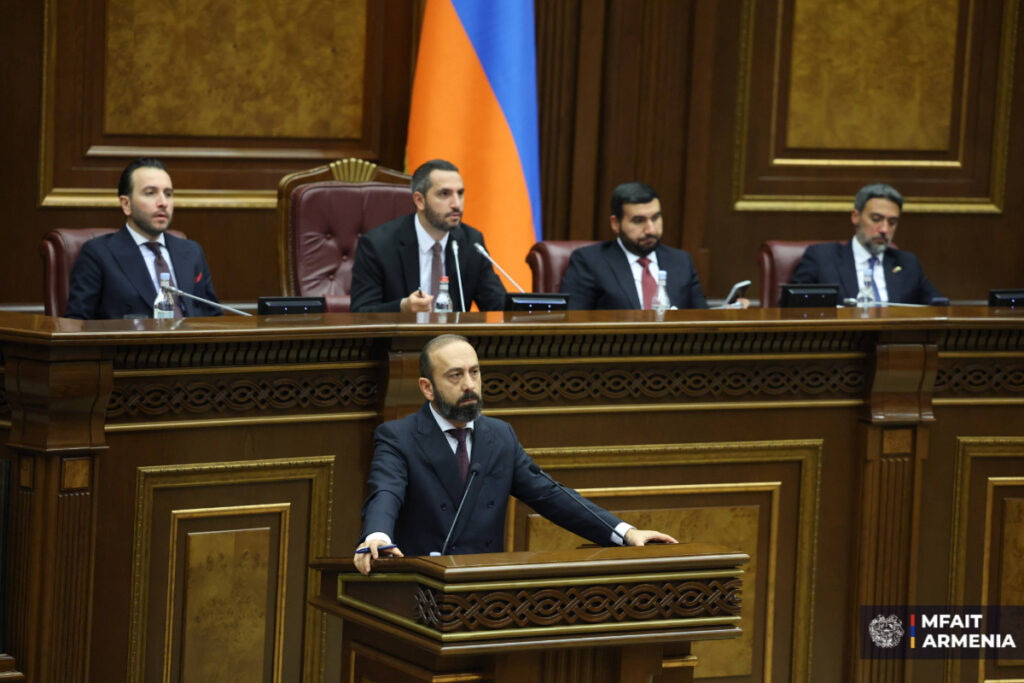
By Hoory Minoyan, originally featured in The Armenian Weekly.
Amid continuing Azerbaijani demands for constitutional changes and growing resistance from parliamentary opposition forces, Pashinyan’s pursuit of a comprehensive peace agreement with Azerbaijan has entered another contentious phase, as the National Assembly voted on Oct. 28 to approve the ratification of the Armenian-American framework agreement on the Trump Route for International Peace and Prosperity (TRIPP), with 63 votes in favor, 32 against and no abstentions.
The National Assembly began plenary consideration of the Armenian-American TRIPP framework agreement on Oct. 27, following its approval by the parliamentary Foreign Relations Committee the previous week. The agreement establishes the framework for developing a transport connection through Armenia’s southern Syunik province, linking mainland Azerbaijan with Nakhichevan, while providing for additional railway, road, energy and communications infrastructure.
Under the proposed arrangement, a joint Armenian-American development company would oversee implementation, with the United States holding a 74% stake and Armenia retaining 26% during an initial 49-year period. The agreement also provides for a possible 50-year extension, under which Armenia’s ownership stake would increase to 49%.
Foreign Minister Ararat Mirzoyan has repeatedly maintained that all infrastructure operating on Armenian territory will remain subject to Armenia’s sovereignty and jurisdiction, including border security, customs administration and law enforcement.
Beyond its stated economic objectives, the government considers TRIPP an important component of its broader peace strategy. During parliamentary discussions, Mirzoyan argued that the establishment of interconnected transport networks would reinforce stability by creating economic interests shared by Armenia, Azerbaijan and other regional actors.
While the proposed route through Syunik is intended to provide Azerbaijan with access to Nakhichevan, the technical arrangements governing Armenian transportation through Azerbaijani territory have yet to be agreed upon in comparable detail.
ARF member and secretary of the opposition Armenia Alliance Artur Khachatryan raised concerns regarding the agreement’s lack of clearly defined reciprocal obligations. He argued that while Armenia commits to providing Azerbaijan with unobstructed connectivity between its mainland territory and Nakhichevan, the corresponding benefits promised to Armenia remain vaguely formulated and are not supported by equivalent legally binding arrangements. According to Khachatryan, neither the Washington declaration nor the subsequent Armenian-American framework specifies which routes Armenia would be permitted to use through Azerbaijan, whether Armenian domestic transportation could utilize TRIPP infrastructure or whether Armenia would enjoy comparable access to the project’s energy and communications components.
Khachatryan also questioned the legal and economic foundations of the arrangement, noting that no comprehensive economic impact assessment had been presented and that the rationale behind the proposed 74% American and 26% Armenian ownership structure remained insufficiently explained. He further warned that Armenia would be undertaking long-term, legally binding commitments without securing equivalent obligations from Azerbaijan, potentially limiting its ability to reconsider the arrangement should the promised reciprocal benefits fail to materialize.
Similar concerns were raised by ARF Bureau member and chair of the Armenian National Assembly Committee on Human Rights and Public Affairs Lilit Galstyan, who argued that TRIPP should be understood primarily as a geopolitical initiative rather than an ordinary transportation project. Galstyan criticized the government’s decision to advance the agreement independently of a comprehensive peace settlement, particularly while Armenian prisoners remain in Azerbaijani custody, territorial disputes remain unresolved and Baku continues to introduce new political demands.
Galstyan also questioned whether the agreement adequately protects Armenia’s sovereign authority over the infrastructure and territory involved. She pointed to the absence of clearly defined geographical boundaries for the project, the possibility of future legislative exceptions and the lack of detailed provisions distinguishing the authority of private operators from the sovereign functions of Armenian state institutions. In her assessment, the repeated recognition of Armenian sovereignty in the agreement does not, by itself, establish sufficient guarantees of effective state control.
The lawmaker further criticized the proposed 49-year arrangement, arguing that the agreement lacks sufficiently developed mechanisms for revising its terms or resolving disputes. She warned that future Armenian governments could consequently find themselves bound by long-term commitments without adequate means of adapting the arrangement to changing national interests or security circumstances.
Criticism of the initiative has also extended beyond parliament. Republican Party of Armenia deputy chairman and political prisoner Armen Ashotyan identified five major projects competing for east-west transit flows: TRIPP, Georgia’s Anaklia deepwater port, the operational Baku-Tbilisi-Kars railway, the Aras corridor connecting Azerbaijan with Nakhichevan through Iran and the Turkmenistan-Iran-Turkey railway.
Ashotyan questioned the commercial viability of constructing new transportation infrastructure through Syunik when alternative routes are already operational or undergoing expansion. Citing estimates placing the cost of TRIPP’s railway, highway, energy and pipeline infrastructure at more than $2.4 billion, he argued that the project would face considerable competition for existing freight volumes.
Ashotyan argued that the proposed route would primarily strengthen connectivity between Azerbaijan and Turkey, while potentially altering the regional balance involving Iran and Russia. In his assessment, the expansion of foreign involvement in strategically sensitive infrastructure could create additional vulnerabilities for Armenia, particularly if tensions between the United States and Iran intensify.
Anna Grigoryan, parliamentary leader of the opposition Armenia Alliance, argued that although the agreement is formally concluded between Yerevan and Washington, Azerbaijan’s strategic interests are more clearly reflected in its provisions than Armenia’s own.
The discussion also exposed the limits of parliamentary scrutiny. Of the 27 lawmakers registered to question the foreign minister during the Oct. 27 debate, only three were able to do so before the allotted time expired. The National Assembly had limited consideration of the agreement to two hours, a restriction that drew objections from deputies seeking further clarification.
In response, Mirzoyan argued that the economic interdependence created by TRIPP would itself encourage reciprocal access. He maintained that Azerbaijan could not meaningfully benefit from transit through Armenia without the broader reopening of transportation connections.
Nevertheless, he acknowledged that the technical details of Armenian transit through Azerbaijan remained subject to future bilateral negotiations.
Parliament Speaker Ruben Rubinyan rejected the opposition’s argument that TRIPP should be contingent on the peace agreement. He maintained that progress on infrastructure and border delimitation should continue independently of Azerbaijan’s refusal to sign the treaty, presenting these developments as separate components of a wider normalization process.
The debate has unfolded against the backdrop of additional statements from Azerbaijan that have further complicated the political environment surrounding the peace process. On Oct. 26, Hikmet Hajiyev, a senior foreign policy adviser to Azerbaijani President Ilham Aliyev, stated that Armenian society should apologize to Azerbaijanis displaced during the decades-long conflict.
He also expressed concern about what he described as revanchist tendencies within Armenian society, while reiterating Azerbaijan’s expectation that Armenia define its future within its internationally recognized borders.
The remarks drew criticism in Armenia, where questions were raised about whether Baku was introducing additional political expectations into a peace process already complicated by unresolved conditions.
During the Oct. 27 parliamentary session, opposition lawmaker Tigran Abrahamyan questioned Foreign Minister Mirzoyan about the absence of an immediate official response to Hajiyev’s remarks. Mirzoyan acknowledged that such statements were not conducive to strengthening peace but cautioned against an exchange of inflammatory rhetoric. He also expressed the view that the demand for an apology could not constitute another precondition for signing the peace agreement.
The exchange was particularly significant given Azerbaijan’s continuing insistence that Armenia amend its Constitution before the bilateral peace treaty can be signed.
Despite the government’s rejection of Azerbaijan’s constitutional precondition, Prime Minister Nikol Pashinyan has continued to pursue the adoption of a new Constitution, a process that increasingly intersects with the country’s broader normalization agenda.
On Oct. 22, Pashinyan publicly acknowledged that he could seek another round of snap parliamentary elections if the government fails to secure sufficient support for its proposed constitutional changes. He stated that the draft Constitution would soon be published and submitted for parliamentary consideration, adding that the government would first attempt to persuade opposition lawmakers before exploring alternative scenarios.
The possibility of snap elections reflects the parliamentary arithmetic facing the government following the June 2026 elections. Civil Contract does not hold the two-thirds majority required to approve the constitutional draft for submission to a referendum. Both opposition blocs represented in the National Assembly have indicated that they will not support constitutional changes they regard as being imposed under pressure from Azerbaijan.
The issue consequently places the government’s peace agenda at the center of a domestic constitutional dispute.
This week’s developments illustrate the increasingly complex relationship between Armenia’s foreign policy commitments and its domestic political constraints. The central challenge for Yerevan concerns whether the ongoing implementation of agreements can produce reciprocal political commitments, particularly when the formal peace treaty remains unsigned.