Armen Rustamyan: Armenia’s National Identity, Sovereignty and Security Are at a Critical Crossroads
25 September 2026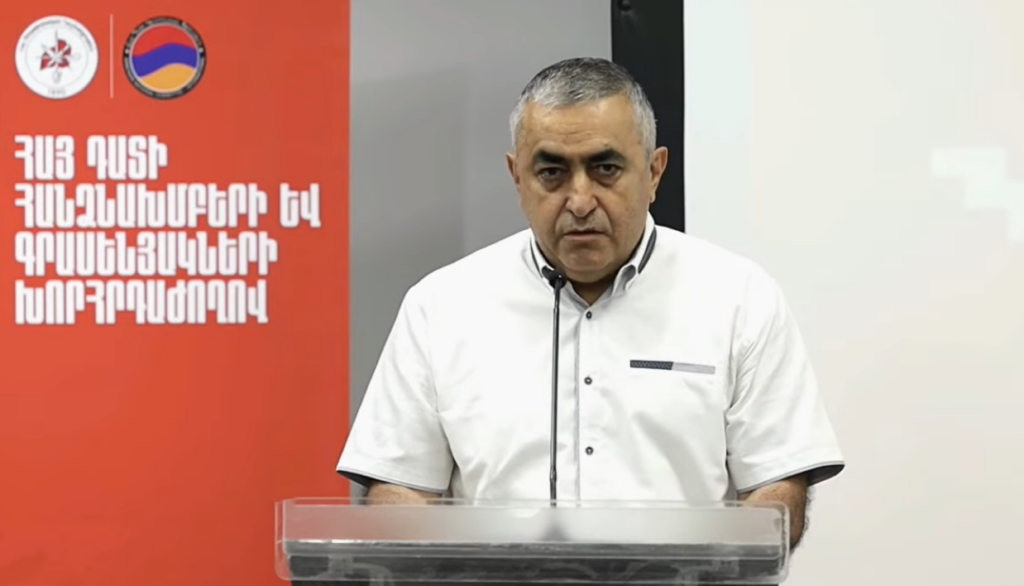
ARF Bureau Representative Armen Rustamyan addressed the official opening of the Conference of Armenian National Committees, focusing on the challenges facing Armenian identity, sovereignty and security, as well as what he described as Armenia’s growing dependence on Turkey and Azerbaijan.
His full remarks follow:
As a result of the military actions unleashed by Azerbaijan against Armenia and Artsakh in recent years, the military-political balance in the South Caucasus has changed significantly.
Under these circumstances, it is necessary to undertake a comprehensive reassessment of the threats facing the Armenian people and the new challenges that have emerged, and to build our future programs and actions on that basis.
Before these military actions, the Armenian National Committees operated from a position of advantage, working to safeguard and consolidate the results of the Armenian victory in the Artsakh liberation struggle. Today, however, they are compelled to confront the grave consequences of defeat and overcome newly emerging challenges.
Accordingly, the foremost priorities facing the Armenian people and our Armenian National Committee structures today are to preserve Armenian identity, Armenian statehood and sovereignty, uphold the inalienable rights of the Armenian people and future generations, and prevent the Turkification of Armenia.
“Turkification” is not some figurative expression. It is a concrete description of a situation in which Armenia becomes politically, militarily, economically and, more broadly, dependent on the Turkish-Azerbaijani tandem across multiple levels and spheres.
It is a situation in which Armenia becomes a country that exists in name but is, in practice, an appendage fully dependent on Turkey and Azerbaijan.
Today, the struggle to advance the issues pursued by the Armenian National Committees, in addition to facing external obstacles, has unfortunately acquired a new internal front.
This is because Armenia’s current ruling regime has, in essence, joined the Turkish-Azerbaijani tandem’s campaign against the defense of the inalienable rights of our people.
For the sake of the peace it has proclaimed, the ruling regime has launched a deliberate process of abandoning national objectives and relinquishing the defense of our vital interests and rights.
By portraying these as sources of conflict, it consistently seeks to undermine the foundations of Armenian identity.
In reality, however, this amounts to an inadvertent admission that the true subject of the conflict between the Armenian people and the Turkish-Azerbaijani tandem is nothing other than our Armenian identity.
Put simply, the message directed at us, as always, is this: as long as you preserve your Armenian identity, there will be no peace.
It is here that we must look for the principal motivation behind the current ruling regime’s chain of concessions aimed at dismantling Armenian identity, as it pursues peace at any cost.
This is also connected to the principal mission of all national forces and our entire Armenian National Committee structure at this historic stage: to break this chain of destructive concessions.
As a nation, we are obliged to do so for the sake of our collective existence.
Indeed, today Armenians both in the homeland and throughout the Diaspora face a crisis of identity and security. These concepts are interconnected: identity without security is defenseless, while security without identity is meaningless.
We must free ourselves from the false ideas introduced by this ruling regime, because within its value system, which glorifies consumerism, being Armenian and achieving victory have no place together.
Here, the rights and interests of Armenians have been replaced by the rights of what they call the “citizen of real Armenia,” while, according to them, success is achieved not through victory but through defeat—and they continuously take pride in the defeats they have brought about.
It was therefore to be expected that the ARF’s opposition to these authorities would become more fundamental. Today, that opposition is increasingly ideological and rooted in competing systems of values.
For us, the components of genuine identity are our common homeland, our mother tongue, the heritage and culture of our generations, and our sacred religion and faith.
For us, genuine security and peace are those guaranteed by the collective strength of the Armenian people and by the support of allied countries for whom the preservation of the Armenian factor and Armenian identity in this region is no less important.
The Armenian people today stand at a fateful crossroads: either establish national authorities, change the country’s current anti-national course, and ensure that Armenia remains genuinely Armenian, or allow the Turkification of Armenia to become a reality if the present course continues.
This is the choice: one or the other.
There is no other reality.
We are here to help our people orient themselves correctly and choose the path of preserving what is national and Armenian.