
“Civil Contract” Blocks Debate on Democratic Backsliding as Galstyan Accuses Ruling Party of Following Baku’s Agenda
17 November 2026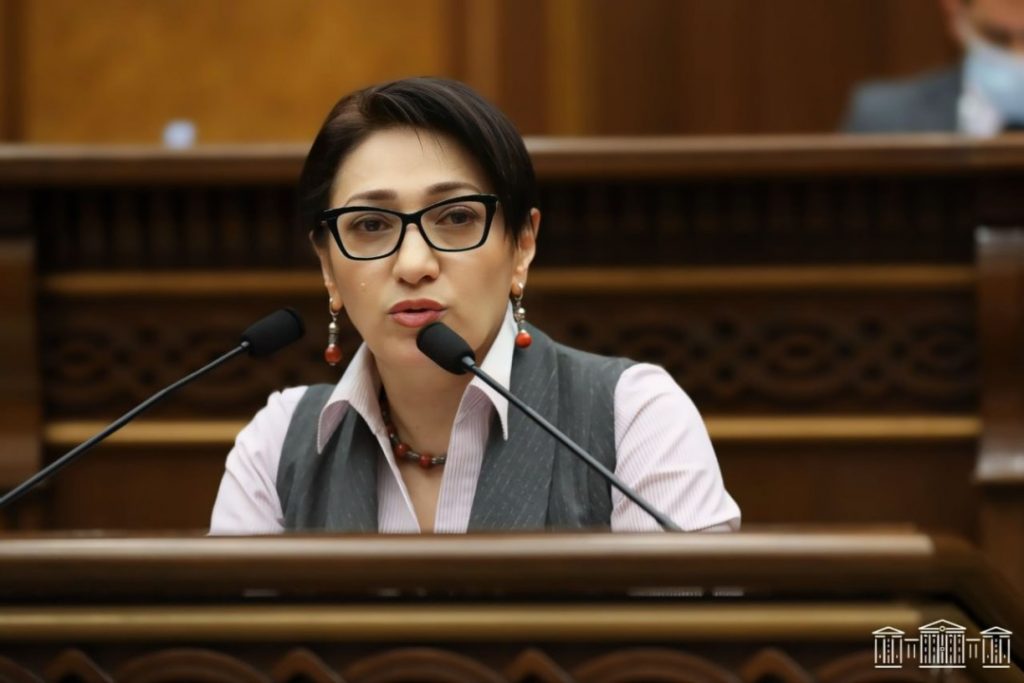
The ruling “Civil Contract” faction used its parliamentary majority on November 17 to block a debate on democratic backsliding and political persecution in Armenia. Lawmakers voted 54–33 against placing a draft statement submitted by the opposition “Armenia” faction on the National Assembly’s agenda.
Lilit Galstyan, an Armenian Revolutionary Federation Bureau member and “Armenia” faction lawmaker, introduced the draft. It addressed the weakening of democratic institutions, judicial independence, politically motivated prosecutions, the disproportionate use of pretrial detention, and restrictions on freedom of expression and assembly.
Galstyan, who chairs the National Assembly’s Standing Committee on Protection of Human Rights and Public Affairs, noted that the “Armenia” and “Strong Armenia” opposition factions had participated in public hearings the previous day. The ruling faction did not attend, she said.
She emphasized that defending democracy and human rights remained priorities for the opposition.
Galstyan also rejected assertions from “Civil Contract” that the opposition was preventing voters from deciding on constitutional changes through a referendum.
“The people held their referendum long ago by casting their votes in the June 7 parliamentary elections. Armenia’s voters have delivered their verdict. This political force does not have the votes needed to hold a constitutional referendum,” she said.
Addressing representatives of the ruling party, Galstyan accused them of advancing a constitution dictated by Azerbaijan.
“No matter how loudly they shout, it remains more than obvious that this constitution is being shaped, that its design is being determined, in Baku, just as Armenia’s domestic agenda is being shaped and dictated in Baku,” she said.
Galstyan described Nikol Pashinyan’s foreign policy as “political tightrope walking,” questioning the consistency of his administration’s dealings with Brussels and Moscow.
“One foot in Brussels, the other in Moscow. All this shows that Armenia lacks a stable framework rooted in its own identity that could halt this chain of capitulation,” she said.
She argued that the ruling party’s overtures toward European institutions were accompanied by similarly deferential statements toward Russia.
“I do not rule out that this same political force treats Moscow with the same enthusiasm and political flattery it directs toward Brussels. Many political figures representing ‘Civil Contract’ lavish extravagant compliments on Russia,” Galstyan said.
She also criticized the controversy surrounding Pashinyan posing with a banana, describing the episode as humiliating for someone representing Armenia.
“If he wanted to send the message that Armenia has become a banana republic, without its own agenda or policy and having lost its identity, then he succeeded,” she said.
Referring to an earlier image of Pashinyan holding a book by Turkish President Recep Tayyip Erdoğan against his chest, Galstyan continued, “If, after holding Erdoğan’s book against his chest, he now holds a banana there, perhaps there is a connection in substance as well.”
She concluded that such conduct carried consequences beyond Pashinyan personally.
“All of this is humiliating and unserious to me, because the world identifies Pashinyan with each and every one of us,” she said.
Following the ruling majority’s rejection of the proposed debate, the “Armenia” and “Strong Armenia” opposition factions are preparing to issue a joint statement.