George Aghjayan highlights collective responsibility at Detroit ARF anniversary
18 November 2026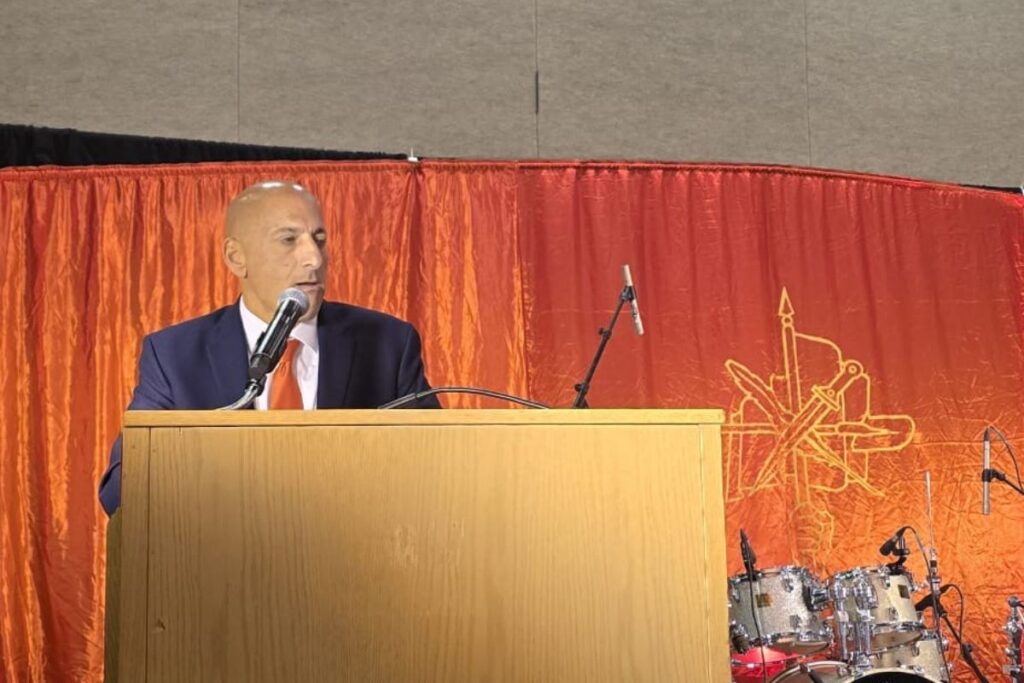
The Detroit ARF Azadamard Gomideh celebrated the ARF’s 136th anniversary on Saturday, Nov. 14, 2026, at Laurel Manor Banquet & Conference Center in Livonia, Michigan.
The celebration featured performances by Karnig Sarkissian, accompanied by Khachig Malkhasian and his band, as well as special guest singer Samvel Yeranyan (Smbul) from Armenia. Proceeds from the event will benefit the new Armenian Community Center in Novi, Michigan.
U. George Aghjayan, chair of the Armenian National Committee of America (ANCA), served as guest speaker, delivering remarks to attendees on the occasion of the ARF’s 136th anniversary.
The following are Aghjayan’s remarks, delivered during the anniversary celebration:
Today, we gather not simply to celebrate the anniversary of an organization, but to celebrate an idea. An idea that has endured for more than 136 years. An idea that has survived genocide, exile, the loss of our homeland, the dispersion of our people, and the countless challenges that history has placed before us.
It is the idea that the Armenian people have the right to determine their own destiny.
It is the idea that being Armenian is not merely an accident of birth, but a responsibility.
And it is the conviction that when Armenians unite in common purpose, there is no limit to what we can accomplish.
Every member of the Armenian Revolutionary Federation, upon entering our ranks, takes an oath:
“I swear on my honor and fatherland to always remain faithful to the ARF Dzrakir, By-Laws, and decisions, and with all my might — if necessary at the cost of my life — to serve the cause of the liberation of Armenia and the Armenian people.”
These are powerful words.
They are not words to be spoken lightly. They are not words that expire with age, with changing circumstances, or when fulfilling them becomes inconvenient.
It is an oath of sacrifice.
But I would argue that for members of the Armenian Revolutionary Federation, that sacrifice was already in their hearts long before they ever took the oath.
The oath did not create their love for the Armenian people.
The oath did not create their devotion to the Armenian homeland.
The oath did not create their willingness to sacrifice.
The oath simply made explicit what was already in their hearts.
It gave expression to a commitment that had already taken root within them. It transformed a deeply personal conviction into a collective responsibility.
And that distinction is fundamental to understanding what the Armenian Revolutionary Federation is.
Because the oath asks us to make not one sacrifice, but two.
The first is our willingness to sacrifice for the Armenian nation.
The second, perhaps less understood and sometimes more difficult, is our willingness to sacrifice a part of our individuality for the collective.
To recognize that our individual talents, our individual resources, our individual ambitions, and even our individual opinions can accomplish so much more when united with those of others in common purpose.
That does not mean surrendering our ability to think independently. It does not mean that we should not question, debate, or challenge one another. Indeed, our organization is strengthened by the diversity of thought, experience, and talent within its ranks.
But it does mean recognizing that no one individual is greater than the cause.
It means accepting that sometimes the best ideas are not our own. That sometimes others will lead. That sometimes our greatest contributions will go unrecognized.
And that sometimes we will be asked to carry out responsibilities that we would not have chosen for ourselves.
It means having the humility to understand that the success of our collective efforts is far more important than the recognition of our individual contributions.
This is the essence of organizational discipline.
This is the essence of ungerutyun.
And this is one of the great strengths of the Armenian Revolutionary Federation.
We have inherited an organization that has demonstrated, generation after generation, that ordinary people, united by an extraordinary commitment, can change the course of a nation’s history.
But what is the ultimate purpose of that commitment?
What is the mission of the Armenian Revolutionary Federation?
At its most fundamental level, I believe it is this:
To defend the right of Armenians to live as Armenians, wherever they may be.
To live as Armenians freely, securely, and with dignity in our homeland.
To live as Armenians in the communities of the Diaspora.
To speak our language. To preserve and develop our culture. To educate our children. To remember our history. To maintain our identity. To exercise our political rights. And to pass on to future generations not simply the memory of what we once were, but the promise of what we can still become.
This is why the work of the Armenian Revolutionary Federation cannot be defined solely in political terms.
It is also the work of building communities.
And it is here that I sometimes find myself puzzled by conversations I have with fellow Armenians.
I hear people praise the Armenian Youth Federation, but then say, “That is not the ARF.”
I hear people praise the extraordinary humanitarian work of the Armenian Relief Society, but then say, “That is not the ARF.”
I hear people praise Hamazkayin for preserving and enriching our culture, but say, “That is not the ARF.”
I hear people praise Homenetmen for developing generations of Armenian athletes, scouts, and leaders, but say, “That is not the ARF.”
I hear people speak with great affection about Camp Haiastan and the profound impact it has had on their children and grandchildren, but say, “That is not the ARF.”
And then, after acknowledging all these extraordinary accomplishments, they turn to me and ask:
“What does the ARF do?”
My dear friends, what do you think the ARF has been doing?
These institutions, each with its own identity, leadership, and mission, are among the greatest expressions of the vision of the Armenian Revolutionary Federation.
They are the embodiment of our understanding that a nation cannot survive through political action alone.
A nation needs educated children.
A nation needs healthy families.
A nation needs artists, writers, musicians, and teachers.
A nation needs young people who understand the value of service, discipline, and leadership.
A nation needs institutions that bring people together, that create a sense of belonging, and that transform individual Armenians into an Armenian community.
When a child at Camp Haiastan discovers the joy of being Armenian, that is the realization of our mission.
When an AYF member discovers that they have the power to make a difference, that is the realization of our mission.
When the Armenian Relief Society extends a helping hand to a family in need, that is the realization of our mission.
When a young Armenian steps onto a stage through Hamazkayin, or wears the uniform of a Homenetmen scout for the first time, that is the realization of our mission.
When an Armenian American activist walks into the halls of Congress to defend the rights of our people, that, too, is the realization of our mission.
All of this is the work of the ARF movement.
And the ARF is even more.
The greatness of the Armenian Revolutionary Federation is not measured by the number of times its name appears on a building, in a newspaper, or on a program.
It is measured by the Armenian lives it has enriched.
It is measured by the communities it has built.
It is measured by the generations it has inspired.
And it is measured by the enduring capacity of the Armenian people to confront the challenges of their time.
We should never forget that the Armenian communities we enjoy today did not emerge spontaneously.
Someone sacrificed to build our churches.
Someone sacrificed to establish our schools.
Someone sacrificed to purchase our community centers, to publish our newspapers, to establish our camps, and to organize our youth.
Someone attended meetings after a long day of work. Someone gave money they could scarcely afford. Someone gave up weekends with their family. Someone accepted responsibilities that others were unwilling to assume.
And most of their names will never appear in the history books.
Yet we are here today because of them.
We are the beneficiaries of sacrifices made by people who often never lived to see the full fruits of their labor.
They built for a future they might never experience.
They built for us.
And now it is our turn.
We live at a particularly difficult moment in the history of the Armenian nation.
We have witnessed the forced displacement of our brothers and sisters from Artsakh. We confront profound challenges to the security of Armenia. Throughout the Diaspora, we struggle against assimilation, indifference, and the gradual erosion of our communal institutions.
At such a moment, it would be easy to become discouraged.
But imagine what our predecessors must have felt.
Imagine the survivors of the Armenian Genocide, arriving in unfamiliar lands, often without family, without resources, without knowledge of the language, and having lost nearly everything.
They had every reason to despair.
Yet they built.
They organized.
They educated their children.
They established institutions that have endured for more than a century.
They refused to allow the circumstances of their lives to determine the destiny of their nation.
And if they could accomplish so much with so little, what excuse do we have today, with all the resources, education, and opportunities available to us?
We must never confuse the difficulties of our time with the impossibility of our mission.
Nor should we measure our responsibilities by the sacrifices of others.
The question is not whether we are being asked to sacrifice as much as those who came before us.
The question is whether we are willing to sacrifice what is necessary of us today.
For some, that sacrifice will be financial.
For others, it will be their time.
For others, it will be their professional talents, their knowledge, or their willingness to assume leadership.
And for many, it will be the simple but profound act of consistently placing the needs of the Armenian community among the priorities of their lives.
Not everyone is called upon to die for the Armenian nation.
But every one of us has the opportunity to live for it.
And living for our nation is not a single heroic act. It is a lifetime of choices, often small and seemingly insignificant, that collectively determine the future of our people.
To our younger generation, I would say this:
The Armenian Revolutionary Federation is not asking you simply to preserve what previous generations have built.
We are asking you to build what previous generations could not have imagined.
Bring your ideas. Bring your creativity. Bring your talents. Bring your questions. Challenge us to do better.
The ARF must never become an organization that is more comfortable celebrating its past than creating its future.
We honor our founders not by attempting to recreate the world in which they lived, but by bringing their courage, their vision, and their revolutionary spirit to the world in which we live.
And to those of us who have been entrusted with the leadership of our organizations, we must remember that our responsibility is not simply to lead, but to develop those who will lead after us.
Our greatest accomplishment will not be what we personally achieve during our lifetimes.
It will be what others are capable of achieving because of what we have done.
On this anniversary of the Armenian Revolutionary Federation, let us renew our commitment to the ideals that have sustained our organization for more than 136 years.
Let us remember that the oath we took was never intended to be a declaration of what we were on a particular day in our lives.
It was a declaration of what we aspired to be every day for the rest of our lives.
Let us remember that sacrifice is not measured only by what we give up, but by what our sacrifice makes possible for others.
And let us remember that the Armenian Revolutionary Federation is not something separate from us, something to which we can assign responsibility and then stand back and judge its accomplishments.
We are the Armenian Revolutionary Federation.
Its strength is our strength.
Its shortcomings are our shortcomings.
Its responsibilities are our responsibilities.
And its future is what we collectively choose to make it.
May we be worthy of those who came before us.
May we fulfill our responsibilities to those who stand beside us.
And may we build a future worthy of those who will come after us.
A future in which every Armenian, wherever they may live, has not only the right to be Armenian, but the opportunity, the means, and the pride to live fully as an Armenian.