The Importance of National Values and the Armenian Church in Preserving Armenian Identity in the Diaspora: Challenges of the New Reality
12 September 2026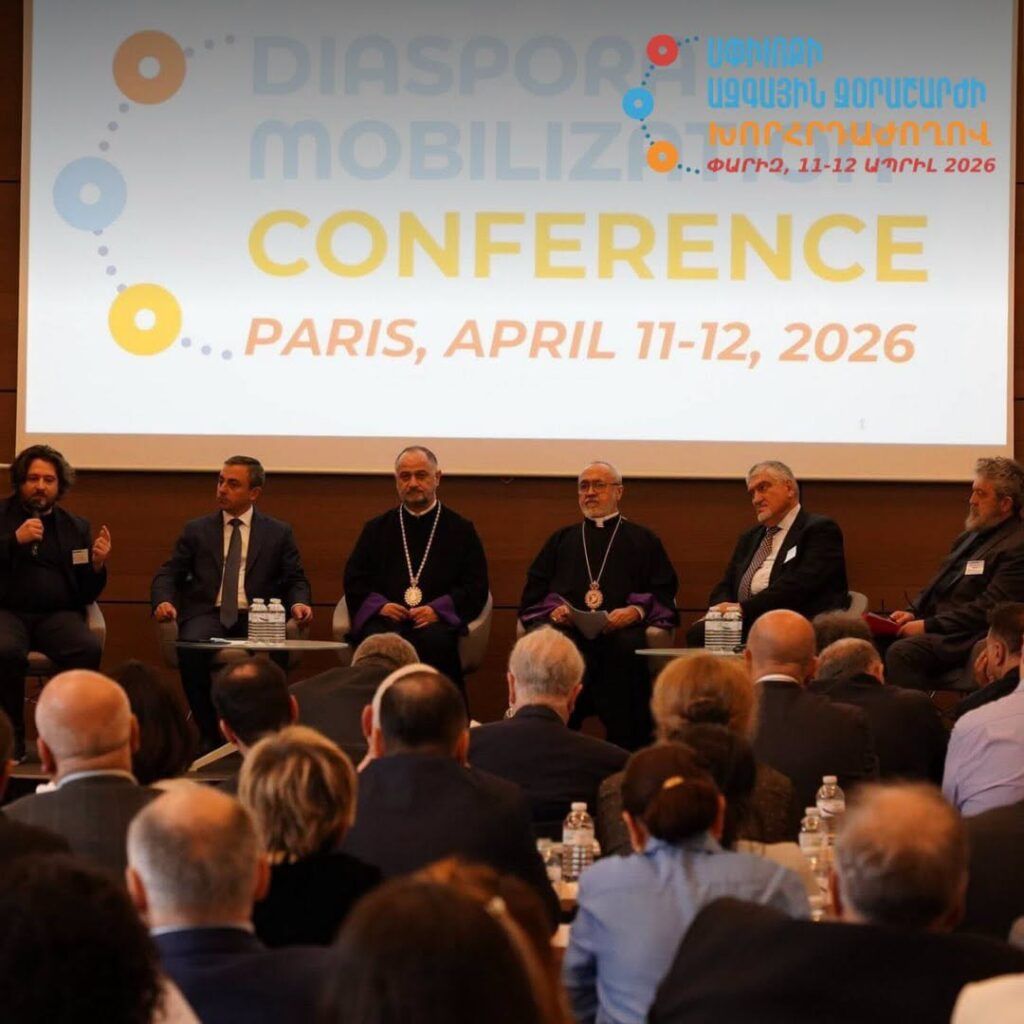
The second roundtable of the Diaspora Mobilization Conference focused on the role of national values and the Armenian Church in preserving Armenian identity across the Diaspora.
Against the backdrop of growing political, demographic, cultural, and identity related challenges, participants discussed how Armenian identity can be preserved and strengthened for future generations. Particular attention was given to the role of the Church, language, education, community institutions, and stronger Armenia Diaspora cooperation as essential pillars of Armenian national life. For more information, visit the official website.
Introduction
The second roundtable of the Diaspora Mobilization Conference was dedicated to examining the role of national values and the Armenian Church in the preservation and development of Armenian identity within the context of the Diaspora. The discussions took place during a period when the Armenian people are facing numerous challenges—political, security-related, demographic, cultural, and value-based. These challenges affect not only the Republic of Armenia but the entire Diaspora, making it necessary to rethink approaches toward preserving Armenian identity, strengthening pan-Armenian cooperation, and enhancing national organization.
Throughout the presentations and discussions, speakers and participants clearly expressed the conviction that the future of the Armenian people depends not only on external circumstances, but first and foremost on our collective ability to preserve our identity, strengthen our values, and coordinate our potential in pursuit of common goals. In this regard, national values—including the Armenian Church, educational institutions, community structures, and Armenia–Diaspora relations—continue to remain the fundamental pillars of Armenian survival and development.
Armenian Identity: From Historical Heritage to a Vision for the Future
At the center of the discussions was the issue of Armenian identity. It was emphasized that for centuries the Armenian people have succeeded in preserving their identity even in the absence of statehood, under conditions of displacement, persecution, and genocide. This reality is not accidental; rather, it is the result of a system of values that was shaped over centuries on the foundations of Armenian history, culture, language, and faith.
Armenian identity was presented as a multilayered reality that includes collective memory, cultural heritage, language, Christian values, responsibility toward the homeland, and the experience of community life. Together, all these elements form the foundation that has enabled the Armenian people to survive and to rebuild themselves during the most difficult periods of history.
At the same time, it was acknowledged that the Armenian identity today faces new challenges. Globalization, the rise of individualism, the influence of multicultural environments, the decline of language use, and the changing conditions of life for younger generations require new approaches to preserving identity. Today, it is no longer sufficient simply to inherit identity; it must be consciously lived, reinterpreted, and transmitted to new generations through approaches that correspond to contemporary realities.
During the discussions, it was emphasized that the preservation of Armenian identity should not be limited to a defensive approach. It is necessary not only to safeguard the heritage received from the past, but also to develop it so that it continues to remain a living, creative, and inspiring force for future generations.
The Armenian Church: The Spiritual Homeland of Armenians and the Core of National Identity
The majority of speakers placed particular importance on the role of the Armenian Church. It was emphasized that, throughout history, the Armenian Church has served as one of the principal foundations for the preservation of the Armenian people’s identity. It is not only a religious institution, but also a center of national memory, culture, education, and collective unity.
It was recalled that the adoption of Christianity was one of the most significant turning points in Armenian history. The creation of the Armenian alphabet, the translation of the Holy Bible, and the development of Armenian literature and culture are closely connected with the mission of the Church. For centuries, the Church became the institution that preserved national consciousness, particularly during periods when state structures were absent.
The discussions repeatedly emphasized that the mission of the Armenian Church remains relevant today. The Church is called not only to preserve the heritage but also to guide Armenians on a path of spiritual, moral, and national renewal. Especially within the Diaspora, the Church continues to serve as one of the unique platforms where Armenians of different generations, backgrounds, and worldviews come together and rediscover their sense of belonging.
The experiences of France and other Diaspora communities demonstrate that communities, schools, and cultural institutions formed around the Church continue to be among the most effective means of resisting assimilation. In places where ecclesiastical and educational structures exist, national life remains more vibrant, and the engagement of younger generations becomes easier.
The Diaspora: A Diverse Yet Unified Pan-Armenian Reality
The present and future of the Diaspora occupied a significant place in the discussions. It was emphasized that following the Genocide, Armenians succeeded in creating organized communities in various countries around the world that preserved the language, culture, and national identity. Schools, churches, cultural organizations, and youth organizations served for decades as the primary instruments of this process.
However, today’s Diaspora is significantly different from that of previous generations. Armenian communities now live within diverse political, economic, and cultural environments. Over time, they have developed different organizational cultures, methods of operation, and ways of thinking. Consequently, the contemporary Diaspora has a multicultural and diverse character.
During the discussions, this reality was viewed not as a problem, but as a source of strength. Armenians living in different countries have accumulated diverse experiences, knowledge, and capabilities that can contribute to the advancement of the entire Armenian nation. This diversity can become a source of national strength if we succeed in organizing and coordinating it around common goals.
For this reason, participants emphasized that one of the key challenges of the future will be developing a culture that encourages mutual recognition, cooperation, and the exchange of experiences. The Diaspora should be viewed as one transnational Armenian entity, whose various segments live within different realities but pursue the same national mission.
Armenia–Diaspora Cooperation: A Pan-Armenian Priority
One of the most frequently recurring themes in the discussions and participants’ reflections was the necessity for closer cooperation between Armenia and the Diaspora.
All participants agreed that the destinies of Armenia and the Diaspora are interconnected. Developments taking place in Armenia have a direct impact on the vitality of the Diaspora, while the Diaspora continues to represent an important human, intellectual, cultural, political, and economic resource for Armenia.
Participants emphasized the need to move toward more practical forms of cooperation. It is not enough merely to speak about pan-Armenian unity; it is necessary to establish clear mechanisms that will facilitate the exchange of knowledge, the sharing of experiences, and continuous collaboration among various organizations and institutions.
Particular importance was given to the issue of engaging young people. Participants stressed the need to create new platforms that will allow youth to become involved in pan-Armenian initiatives, develop leadership skills, and participate in decision-making processes. The preservation of Armenian identity and the future of pan-Armenian cooperation will largely depend on the active involvement of younger generations.
Conclusion and Proposed Directions
Based on the ideas expressed during the discussions and the responses of participants, it can be stated that the preservation of Armenian identity continues to remain a pan-Armenian priority. However, the policies advanced by the authorities of the Republic of Armenia seek to reshape Armenian identity by contrasting a “real Armenia” with historical Armenia, thereby creating a deep division within national consciousness. This process is expressed through educational, historical, and symbolic changes (the diminishing of the significance of Artsakh and the Genocide, the Turkification of place names, and other developments) and is accompanied by a weakening of patriotic sentiment. At the same time, attacks against the Church and these changes are viewed as concessions to pressure from Turkey and Azerbaijan. As a result, the divide between Armenia and the Diaspora deepens, placing the preservation of collective memory and national identity at risk.
At the same time, the discussions demonstrated that there is a need to adopt more practical approaches. Participants repeatedly emphasized that unity around national objectives must be accompanied by concrete actions, coordinated efforts, and sustained cooperation.
In this direction, the following priorities were considered particularly important:
Finally, the overall message of the roundtable was that the challenges facing the Armenian people can only be overcome through a united, organized, and cooperative global Armenian community. Armenian identity, national values, and the Armenian Church continue to serve as the foundations of this collective strength.
However, success in the future will depend on our ability to build upon these foundations by creating new forms of cooperation, new initiatives, and a new vision that will serve the long-term development and vitality of the Armenian people.