Mobilizing and Revitalizing the Diaspora in Support of Pan-Armenian National Goals
18 September 2026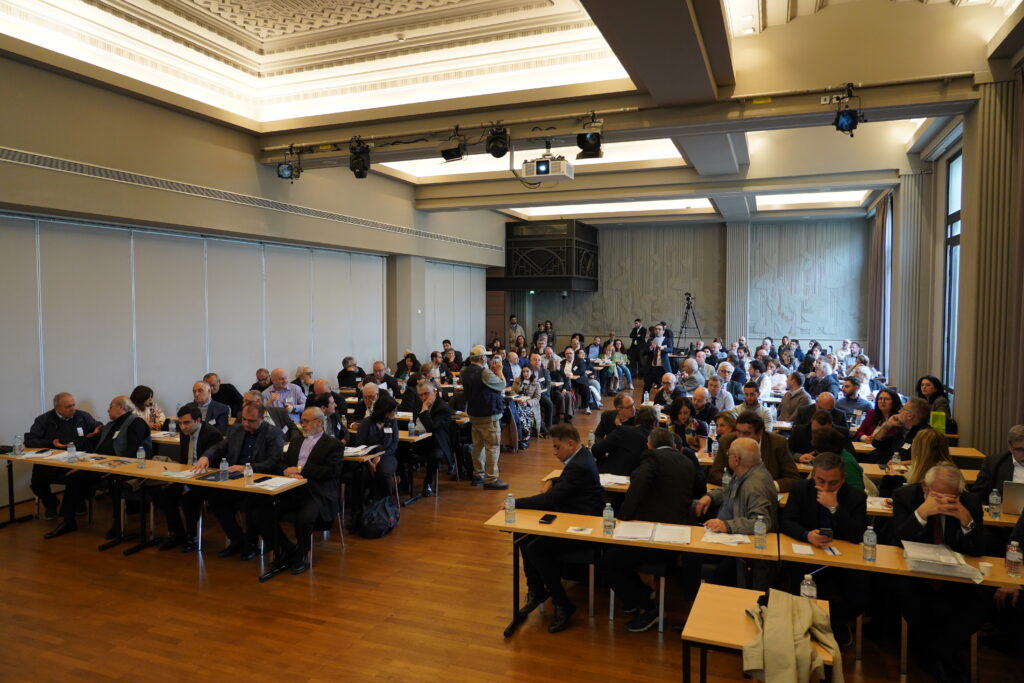
The Diaspora Mobilization Conference, held in Paris on April 11–12, brought together participants for four roundtable discussions focused on the role of the Diaspora, national identity, Armenia–Diaspora relations, and the broader challenges and prospects of pan-Armenian organization.
The fourth and final roundtable examined key issues facing the Armenian Diaspora and explored strategic, political, educational, and organizational directions for the future. The summary below presents the main ideas and recommendations raised during the discussion.
More information about the conference, its participants, and the roundtable topics is available on the conference’s official website.
ROUND TABLE 4
The role of the Diaspora needs to move beyond the traditional confines of charitable and cultural activities and be positioned within the spheres of international law and political influence. This approach views the Diaspora as a strategic actor.
The concept of conducting diplomacy parallel to that of the Armenian state is theoretically attractive, but in practice it remains dependent on the political will of the states from which intervention is expected. International law often functions within the constraints of power politics rather than through the consistent application of legal principles alone.
The concept of the “Right of Diasporas” is both innovative and thought-provoking. However, the current international system is still fundamentally based on the principle of sovereign states. Consequently, this concept should be regarded more as a long-term vision than as a political program that can realistically be implemented soon.
Strategic Proposal: Establish a Global Armenian Legal and Diplomatic Network
To ensure that the influence of the Armenian Diaspora becomes coordinated, institutionalized, and sustainable over the long term, it is essential to establish a permanent global network bringing together:
The principal mission of this network would be to:
Genocide as an Ongoing Process
The genocide perpetrated against the Armenian people should not be viewed solely as the historical events of 1915, but rather as a continuing, organized, and progressively unfolding process.
Strategic Proposal: Establish a Global Armenian Security Council
The central premise is that the Armenian people need a permanent institution that addresses genocidal threats not merely as historical or legal issues, but as matters of national security.
Global Armenian Educational Renaissance 2040
Throughout history, the Armenian people’s survival has depended not only on statehood or military victories, but also on the creation of a strong national identity rooted in culture, language, and education.
This approach examines the issue from a 50- to 100-year perspective, focusing on the factors that determine the nation’s survival across successive generations.
National identity is preserved through institutions. Historical experience demonstrates that the Armenian nation’s greatest achievements have resulted from investments in education and culture. A realistic assessment of today’s demographic and cultural challenges—particularly the statistics regarding Armenian schools—indicates that the current system is inadequate to meet long-term needs.
Accordingly, it is proposed to establish the “Global Armenian Educational Renaissance 2040” initiative, with the following objectives:
Strengthening the Organizational, Financial, and Political Capacity of the Diaspora
Another major area of focus centers on the practical requirements for strengthening the Armenian Diaspora organizationally, financially, and politically by improving its systems of governance, organization, and influence.
The principal strength of this approach lies in its practical and realistic nature. Since most of the Diaspora is not directly engaged in Armenian national activities, it is essential to reach these broader communities. Emphasis is placed on financial independence, as sustainable economic infrastructure is indispensable for long-term effectiveness. Equally important is distinguishing between the Armenian state and its government, so that political disagreements do not evolve into indifference toward the interests of the state itself.
Accordingly, it is proposed to establish a “Global Armenian Diaspora Development and Endowment Fund,” with the following primary objectives:
Diaspora Mobilization Conference
September 18, 2026