The Strategic Role of the Diaspora in Addressing National Challenges: What Should the Diaspora’s Political Agenda Be?
07 September 2026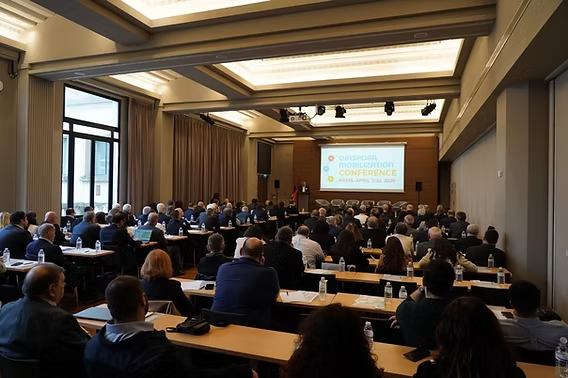
The following text is from the summary of a roundtable discussion held during the Diaspora Mobilization Conference in Paris on April 11–12.
For more information about the conference, participants, and roundtable discussions, visit spyurkconference.org.
The Armenian Diaspora, by its very nature, is a political phenomenon, because it was created as a result of historical and political circumstances and has served national and political objectives throughout its existence. In its present form, it embodies a legacy spanning many decades, with both significant achievements and notable shortcomings. Although the Diaspora has continued to evolve in other ways over time, those developments have not altered its fundamental character or identity.
There is a need for a strategy that improves the life of the Diaspora, strengthens its vitality and resilience, and elevates its effectiveness through better communication and structural reform.
To preserve and develop Armenian identity, the Diaspora must refresh its approaches and its institutional toolkit, with the goal of expanding its reach and accessibility while fostering greater cooperation among its principal stakeholders. An important element of this toolkit is the strengthening of Armenia–Diaspora relations. Equally vital is instilling national values in Armenian youth, encouraging them to assume responsibility, and entrusting them with overcoming a range of future challenges.
It is also essential to develop the Diaspora’s economic potential and channel it toward advancing a pan-Armenian agenda, while using that economic strength as a means of securing a seat at the table where international interests are shaped and negotiated.
The Diaspora’s strategic role in addressing national issues need be complementary to that of the Armenian state and, whenever possible, coordinated with it. Under the current circumstances, however, it will often be necessary to work independently of the official Republic of Armenia (represented by its present authorities) and the concept of “Real Armenia.” The strategy of capitulation embodied in the “Real Armenia” doctrine is not a path to peace. Rather, it is a strategy of managed decline, continuously diminishing expectations, and ultimately national self-destruction. It cannot guarantee the nation’s security today and, even more tragically, it closes the door to any genuine peace founded upon justice in the future.
In this context, the Armenian nation—primarily through the efforts of the Diaspora—must reorganize itself and develop and refine global instruments of influence that will enable it to become an indispensable and irreplaceable force for the survival of both the Armenian state and the Armenian nation.
The Armenian nation is at its strongest when its state agenda and its pan-Armenian national agenda complement one another, advancing along parallel paths toward the same objective. In reality, these agendas are mutually reinforcing. Portraying them as conflicting—or setting them against one another—is both artificial and detrimental to the interests of the entire nation, including the survival and well-being of the Armenian state itself.
Ideally, the Diaspora and the Armenian state should function as independent actors pursuing the same overarching goal. When the state comes under pressure, the nation must be able to remain steadfast. By operating independently, it becomes possible to circumvent policies that undermine our state and jeopardize the nation’s long-term security.
The Diaspora’s strategic national role in addressing pan-Armenian challenges is ultimately determined by the extent to which the Diaspora itself is willing to assume that role. To this end, its political agenda should include two closely interconnected priorities: first, creating a mechanism through which the collective political will of the Diaspora can be expressed; and second, integrating that collective political will into the political agenda of the Republic of Armenia. These objectives can be pursued through elections or other forms of collective organization, both of which require broad pan-Diasporan and pan-Armenian discussion. Taking into account all opportunities and potential obstacles, the Diaspora itself must determine the priorities, direction, and course of its political agenda.
Society in the Republic of Armenia is weary, demoralized, and disillusioned. The determination that existed in the 1990s no longer exists today. Armenia’s reality is fundamentally different from what it was just six or seven years ago, when there was a shared pan-Armenian agenda pursued by a “trinity” of actors: the Republic of Armenia, the Republic of Artsakh, and the Diaspora. Today, only one principal actor remains committed to advancing that same pan-Armenian agenda: the Diaspora. The authorities of Artsakh no longer possess the resources and capabilities they once had. Meanwhile, the third actor—the Republic of Armenia, represented by its current government—not only has ceased to pursue the issues of Artsakh and the Armenian Genocide, but has taken the opposite approach by attempting to prevent, or at the very least hinder, the other actors from advancing those causes as well.
As a result, the responsibility for raising and defending issues on the pan-Armenian agenda has fallen largely upon the Diaspora. This is especially true with respect to Artsakh. Following the 44-day war of 2020, Azerbaijan’s genocidal policies, and the complete depopulation of Artsakh’s Armenian population in 2023, the scope of these issues has broadened considerably. It now encompasses the protection of the rights of forcibly displaced Armenians and prisoners, as well as the preservation of Artsakh’s historical and cultural heritage.
At the same time, the campaign directed against the Armenian Apostolic Church—the oldest institution of the Armenian nation—cannot be reconciled with any legitimate national agenda. Consequently, defending the Armenian Apostolic Church against this campaign has itself become an integral part of the pan-Armenian national agenda.
The Diaspora, through its diverse institutions and the capabilities of influential individuals, possesses the capacity to defend Armenian interests, preserve our heritage, and advance Armenian aspirations across all six inhabited continents. This potential can complement the forward-leaning elements of state diplomacy by elevating Armenian issues on the international stage, formulating and advocating policy positions, defending the rights of the Armenian people, and expanding the Republic of Armenia’s sphere of influence in ways that differ from the traditional tools of state diplomacy. For the Armenian nation to endure, the global Armenian community is called upon to act as the sovereign master of its own destiny—a developing homeland supported by a Diaspora that is itself a geopolitical force.
In many respects, the Armenian Diaspora today constitutes an independent geopolitical force, more influential than the governments of many countries. It operates within a global environment shaped by intense competition and conflict between nation-states and transnational networks. In this context, one of the principal objectives of the Diaspora’s political agenda must be to support efforts aimed at ensuring the security and survival of the Armenian state.
Expanding the Diaspora’s potential and placing that potential in the service of the pan-Armenian agenda also requires initiatives that, while non-political in form, are inherently political in substance. Such initiatives include mapping and assessing the Diaspora’s human, institutional, and economic resources; increasing the presence and influence of Armenians in global policy, academic, technological, media, and civil society platforms; preserving existing Armenian historical and cultural centers while establishing new ones; strengthening ties and cooperation among Armenian communities worldwide; and protecting and sustaining vulnerable Armenian communities.