Calls for collective opposition amid targeted discrimination against civilians
16 April 2026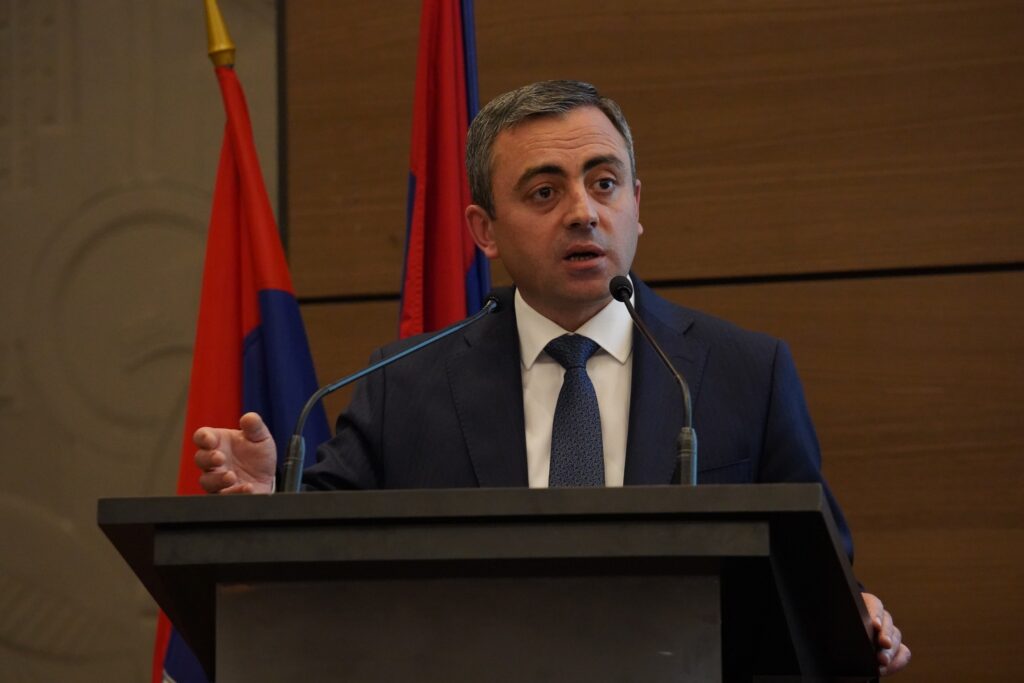
By Hoory Minoyan, originally featured in The Armenian Weekly.
YEREVAN — At a briefing held on Wednesday, Armenian Revolutionary Federation (ARF) Armenia Supreme Body Chairman and Armenia Alliance lawmaker Ishkhan Saghatelyan accused the Pashinyan government of consolidating an increasingly authoritarian system. He said authorities are prepared to “take any step, any unlawful action” in order to preserve their rule.
Saghatelyan referred to arrests carried out on Tuesday, including the detention of activist Gohar Ghumashyan and Verzhine Stepanyan, along with the continued detention of Archbishop Bagrat Galstanyan and others, as part of what he described as an expanding pattern of political pressure.
According to opposition representatives and legal commentators, Ghumashyan was detained in connection with allegations involving the provision of assistance under the guise of charitable activity ahead of upcoming parliamentary elections.
Saghatelyan said the developments highlight the need for deeper coordination among opposition forces. He urged political groups to set aside electoral competition and instead cooperate on fundamental national priorities, reiterating his proposal for a joint opposition rally.
“This is a political struggle, and we have made it clear that opposition political forces are partners in today’s and tomorrow’s struggle, not targets. If the removal of this government depends on such cooperation, we are ready to cooperate.”
He added that despite electoral rivalry, the current political environment requires unified action and that the recent arrests necessitate a coordinated response from the opposition.
Saghatelyan’s remarks on the need for closer coordination among opposition forces come amid broader political debate within the opposition camp over institutional stability, public safety and political accountability.
The case was strongly criticized by members of the “Strong Armenia” Alliance, including Alik Alexanyan, who described the detention as politically motivated and argued that women and young mothers were being disproportionately targeted.
Legal expert Aram Vardevanyan said the detention took place near the Anti-Corruption Committee and questioned its proportionality, emphasizing that standard procedural practice typically takes into account personal circumstances such as motherhood when applying coercive measures.
Public demonstrations also took place in support of Ghumashyan, with citizens gathering near the Anti-Corruption Committee building. Protesters placed milk bottles at the site as a symbolic gesture of solidarity. It was reported that Ghumashyan is the mother of a 2-month-old child, and that her husband brought the infant to the location of her detention so she could breastfeed during the process.
Opposition representatives also criticized the detention of Verzhine Stepanyan, coordinator of the Vayk office of the “Strong Armenia” Alliance. According to the Investigative Committee, a public criminal prosecution was initiated against her on charges of obstructing or coercing participation in assemblies, or materially incentivizing participation or nonparticipation in public gatherings.
Authorities later confirmed that both Gohar Ghumashyan and Verzhine Stepanyan were released from detention. However, preventive judicial measures were applied in both cases. Accordingly, a noncustodial restrictive measure — administrative supervision or judicial control — has been imposed on both individuals pending further proceedings.
Further criticism came from the “I Have Honor” parliamentary faction. Lawmaker Tigran Abrahamyan condemned what he described as unlawful and disproportionate state actions, arguing that the use of arrests and coercive measures against political opponents, nursing mothers, minors and clergy reflects an increasingly indiscriminate exercise of power. He called on opposition forces to base their strategy on what he described as the authorities’ “anti-political, anti-legal and anti-moral toolkit.”
In line with Saghatelyan’s call for a coordinated opposition, former Foreign Minister Vartan Oskanian said Armenia’s opposition has largely taken shape ahead of the parliamentary elections scheduled for June 7.
Oskanian said opposition electoral lists have already been published and programs presented, arguing that they reflect a broadly shared agenda centered on peace, economic development, poverty reduction, restoration of justice, national revival and unity.
He said it was time to consolidate the concept of a “collective opposition” in public perception, describing the process not as an accumulation of individual political efforts, but as a unified political project with a common objective.
According to Oskanian, the emphasis should now shift from fragmentation to coordination. He expressed confidence that such a consolidated opposition would prevail in the upcoming elections but stressed that electoral victory alone would not be sufficient.
He said the opposition should set a higher political threshold, saying the goal should not merely be preventing the reelection of Prime Minister Nikol Pashinyan’s political force, but ensuring that the ruling party does not cross the parliamentary threshold required for representation.
Oskanian said only such an outcome would allow Armenia to close the chapter on the past eight years and relegate the current political period to history.