
IRI’s Armenia Survey Misleads the Public
29 May 2026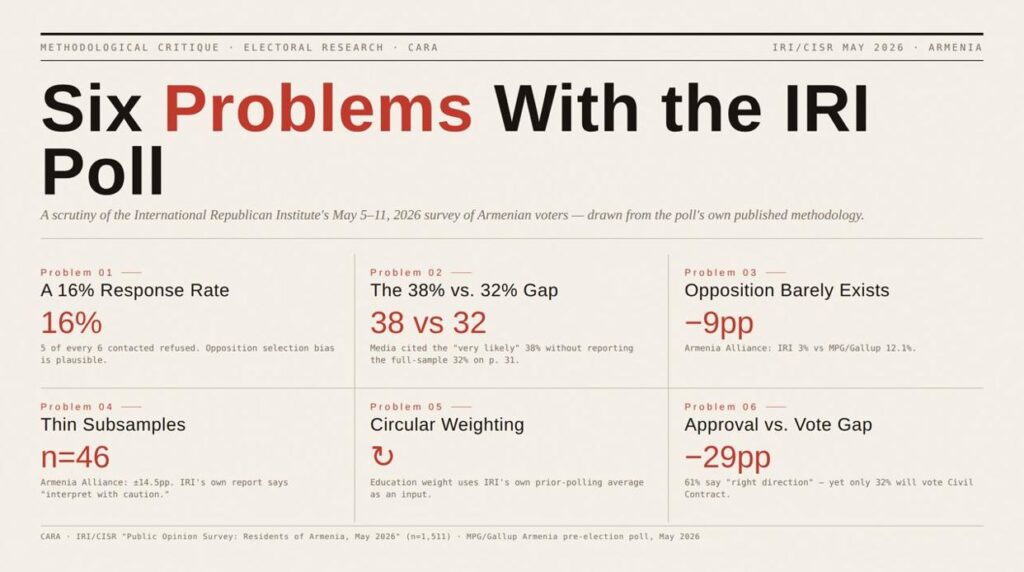
How a 16% Response Rate Became a 38% Headline and
The Poll That Buried its Own Bad News
The International Republican Institute released a widely cited pre-election survey ahead of Armenia’s June 7, 2026 parliamentary vote. Reading the fine print reveals a more complicated picture than many headlines suggested.
When the International Republican Institute published its May 2026 pre-election survey of Armenian voters, the story wrote itself. Civil Contract — Prime Minister Nikol Pashinyan’s ruling party — was polling at 38%. The opposition was fragmented, with no single challenger cracking double digits. Pashinyan, the data seemed to say, was cruising toward another term.
That narrative is not genuine. It is built on a series of methodological choices that, taken together, systematically favor the ruling party, and the way the poll was presented to the public made those choices almost impossible to see.
The Number That Led Headlines
Start with the 38% figure itself. Multiple Armenian media outlets cited it as the poll’s headline finding for Civil Contract, identifying it as the figure for “very likely” voters, but without clarifying that the full-sample figure told a meaningfully different story. What almost no coverage mentioned is that 38% is not what the poll actually found when you ask everyone in the sample.
Buried on page 31 of the published report is the full-sample vote intention question. There, Civil Contract registers 32% — six points lower than the widely cited figure. The 38% applies only to respondents who said they were “very likely” to vote, a filtered subsample of 1,186 people out of the 1,511 surveyed.
Filtering to likely voters is a legitimate and widely used technique in election polling. The problem is not that IRI did it. The problem is that the 38% figure circulated publicly without the 32% figure receiving equal prominence — leaving readers with an incomplete picture that the poll’s own authors had every opportunity to clarify.

When 84% of People Hang Up
The filtered headline figure becomes more concerning once you understand what the survey was drawing from to begin with.
IRI’s methodology section, page 2 of the published report, states the survey achieved a 16% response rate. Read that again: for every Armenian who completed the interview, roughly five others did not engage. They hung up, did not answer, or were deemed ineligible after contact attempts.
In survey research, a low response rate is not automatically disqualifying. What matters is whether the people who declined to participate differ systematically from those who agreed. And, in Armenia’s polarized political environment, a reasonable basis exists for concern. IRI is a U.S.-funded “democracy-promotion” organization with a long track record of supporting “civil society development” in countries like Armenia. Opposition supporters, many of whom distrust Western-aligned institutions as much as they distrust the current government, may be disproportionately represented among the 84% who declined. If that is the case, the sample is skewed before a single response is recorded.
IRI does not address this risk in its published materials. The 16% figure appears in the methodology section, but its implications for the results are not discussed. A reader who does not know to look for it, typical of most readers, would have no way of knowing it existed.
The Opposition That Barely Shows Up
The response rate problem has a concrete manifestation in the poll’s treatment of opposition parties.

IRI’s data shows Strong Armenia, the newly formed vehicle of Samvel Karapetyan and a potentially formidable opposition challenger, at just 6%. The Armenia Alliance, led by former president Robert Kocharyan, registers at 3%. Prosperous Armenia comes in at 2%.
These numbers are dramatically lower than what other polling in the same period shows. MPG/Gallup’s concurrent survey found Strong Armenia at 14.9%, the Armenia Alliance at 12.1%, and Prosperous Armenia at 8.7%. The gaps, roughly 9 points each on Strong Armenia and Armenia Alliance, are far too large to be explained by the likely-voter filter alone.

What the filter cannot explain, the sample composition may. Page 3 of the IRI report includes a table of subsample sizes broken down by party preference. The Armenia Alliance supporter group contains just 46 respondents. At that sample size, the margin of error exceeds ±14 percentage points, meaning the true figure could be anywhere from essentially zero to nearly 17%. The report includes a footnote acknowledging that data for this group “should be interpreted with caution due to small sample size.” That caution does not appear in the press release. Cross-tabulations based on this 46-person group, how Armenia Alliance supporters view the economy, foreign policy, the fairness of the election, appear throughout the published report as if they were reliable findings.
Weighting That Looks in the Mirror
The methodological picture contains a third layer, less visible than the response rate but equally significant.
IRI describes its education weighting on page 2 of the report: the sample was weighted “according to the midpoint between the 2022 census data for those aged 18+ and the educational attainment level of IRI’s polling average.”

This is an unusual formula. Standard practice is to weight a sample against an external, independent benchmark, such as census data, to correct for sampling imbalances. What IRI describes instead is a hybrid: half census, half its own prior polls. The problem with using your own prior polls as a weighting input is that it is circular. If IRI’s previous surveys overrepresented pro-Western respondents, a plausible concern given the response rate pattern, then those biases are now embedded in the weighting target for the current survey. The correction mechanism itself contains the error it is meant to fix.
A Poll at War With Itself
Perhaps the most revealing problem is one that exists entirely within IRI’s own data, requiring no external comparison to identify.
The poll finds that 61% of Armenians say the country is heading in the right direction. It finds that 62% say they are satisfied with the work of the Prime Minister’s Office. These are strong numbers for any incumbent government. In most political environments these numbers would translate into a commanding vote share for the ruling party.
Yet the same poll finds that only 32% of respondents say they would vote for Civil Contract.

That gap, between 61-62% expressing approval and 32% expressing vote intention, is not a normal feature of Armenian politics or any democratic electorate. Governments that two-thirds of voters think are doing a good job do not typically poll in the low 30s on vote intention. Something is wrong, and the poll does not say what.
The most likely explanation is that the same sampling bias running throughout the response rate and weighting is inflating the approval numbers while the vote intention question, which requires a more definitive commitment, partially corrects for it. In other words, the poll’s internal contradictions are themselves evidence that the sample is not representative of the electorate as a whole.
What the Poll Is And Is Not
None of this means the IRI survey is worthless or fabricated. IRI publishes its full methodology, its subsample sizes, and its raw cross-tabulations, providing a level of transparency that actually makes this critique possible. The organization has conducted serious, rigorous research in Armenia for years, and its longitudinal data on public attitudes toward institutions, foreign policy, and the direction of the country is genuinely valuable.
The problem is not the poll. The problem is the gap between what the poll can reliably support and what public presentation of it invited people to believe.
A survey with a 16% response rate, a self-flagged opposition subsample of 46 people, a circular weighting formula, and a headline figure drawn from a filtered subsample rather than the full sample is a useful, but limited, instrument. It almost certainly tells us something real about Civil Contract’s support. It almost certainly tells us very little about the true state of opposition sentiment. And a figure of 38% — circulated without noting that the full-sample figure is 32%, that the Armenia Alliance subsample is flagged as unreliable, or that 84% of contacted Armenians did not participate, is not a complete or fully honest account of what the data shows.
Ahead of a consequential election on June 7, 2026, Armenian voters and international observers deserved to know the difference.
All figures and methodological details drawn directly from IRI/CISR “Public Opinion Survey: Residents of Armenia, May 2026” (fieldwork May 5–11, 2026; n=1,511; conducted by Breavis/IPSC LLC). Margin of error estimates for subgroups calculated using standard formula ±1.96√(p(1−p)/n) at the 95% confidence level.
The Center for Armenian Research and Analysis (CARA) is a trans-national institute that provides investigative, analytic, and informational resources to public and private entities across the Armenian experiential spectrum.