
Following the Signing of the TRIPP Framework Agreement, ANC-International Updates Its Policy Brief
04 June 2026 Armenia and the United States have signed the Framework Agreement between the Republic of Armenia and the United States of America on Strategic Cooperation Concerning the Trump Route for International Peace and Prosperity (TRIPP).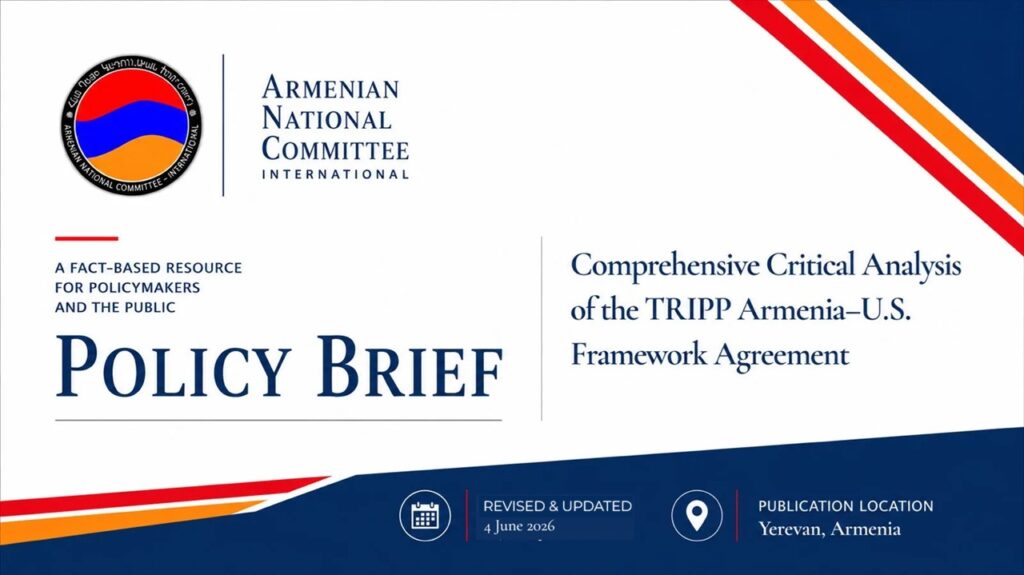
Pursuant to the understanding reached in Yerevan on May 26, Armenian Foreign Minister Ararat Mirzoyan and U.S. Secretary of State Marco Rubio signed the Agreement remotely. Secretary Rubio signed the document in Washington on June 1, while Foreign Minister Mirzoyan signed it in Yerevan on June 4.
“With this, the remote signing process is complete, and the Agreement is ready for ratification,” Foreign Minister Mirzoyan stated.
In light of the signing of the Agreement, the Armenian National Committee–International (ANC-International) has revised and updated its Policy Brief: Comprehensive Critical Analysis of the TRIPP Armenia–U.S. Framework Agreement, originally published on May 29.
Below are the revised Introduction, Conclusion, and infographic of the updated Policy Brief. The full document may be downloaded here.
Introduction
Produced by the Armenian National Committee – International, this analysis examines the “Framework Agreement between the Republic of Armenia and the United States of America on Strategic Cooperation Concerning the Trump Route for International Peace and Prosperity (TRIPP),” signed by the Foreign Minister of the Republic of Armenia on 4 June 2026 and by the United States Secretary of State on 1 June 2026, following its initialling on 26 May 2026. The Agreement stems from the tripartite Armenia–Azerbaijan–United States understandings reached in Washington D.C. on 8 August 2025 and constitutes the principal legal framework governing the implementation of the TRIPP initiative. The Washington tripartite agreement called for “unimpeded connectivity between the main part of the Republic of Azerbaijan and its Nakhchivan Autonomous Republic through the territory of the Republic of Armenia, with reciprocal benefits for international and intra-state connectivity for the Republic of Armenia.”
While the signed Framework Agreement establishes extensive institutional, governance, and implementation mechanisms for the realization of this objective, the nature, scope, and enforceability of the promised “reciprocal benefits” for Armenia remain among the central issues examined in this analysis.
The TRIPP initiative has been presented by its proponents as a connectivity- and peace-oriented regional infrastructure project intended to facilitate multimodal transit between mainland Azerbaijan and the Nakhichevan Autonomous Republic through the sovereign territory of the Republic of Armenia, while simultaneously contributing to regional stability, economic development, and broader international trade integration. Senior officials of both governments have described the Agreement as a major step toward implementation of a new regional trade and transit corridor and have emphasized its potential contribution to peace and prosperity in the South Caucasus.
This analysis focuses primarily on the legal, constitutional, institutional, governance, economic, environmental, and sovereignty-related implications of the signed Framework Agreement rather than on broader geopolitical considerations alone. While geopolitical considerations inevitably form part of the wider context, this document seeks principally to evaluate the obligations, governance structures, rights, limitations, and potential long-term consequences arising from the Agreement itself.
The analysis identifies a number of significant concerns arising from the current structure of the Agreement, including the granting of long-term exclusive rights over strategically important infrastructure located on Armenian sovereign territory, the establishment of a foreign-majority-controlled governance structure, extensive derogations from Armenian domestic legislation, preferential fiscal treatment, weak dispute resolution mechanisms, undefined governance procedures, the absence of enforceable reciprocal connectivity rights for Armenia, and the lack of meaningful environmental safeguards or public accountability mechanisms.
With the signing of the Agreement, the text can now be regarded as politically finalized and no longer subject to substantive renegotiation in the ordinary course of the ratification process. Accordingly, this analysis is not intended as a commentary on hypothetical future provisions but as an assessment of the legal and institutional framework that Armenia has agreed to submit for ratification and eventual implementation.
The central concern raised by this analysis is therefore not opposition to regional connectivity or economic cooperation as such, but rather the possibility that the TRIPP Framework Agreement, in its current form, institutionalizes a deeply asymmetric legal and governance structure that does not provide enforceable reciprocal connectivity rights for Armenia and may significantly constrain the country’s future strategic autonomy while exposing it to long-term sovereignty, governance, economic, environmental, and security risks in the absence of sufficient safeguards, reciprocity, and democratic oversight.
Conclusion and Strategic Assessment
The signing of the Framework Agreement on 4 June 2026 marks a significant milestone in the implementation of TRIPP and transforms the initiative from a political concept into a concrete interstate legal framework awaiting ratification and implementation.
The Agreement can no longer be viewed merely as a prospective infrastructure proposal. It establishes a long-term governance architecture governing strategic infrastructure, land use rights, concession arrangements, taxation, regulatory obligations, and institutional decision-making structures that may remain in place for up to ninety-nine years. As such, its implications extend well beyond transportation policy and touch upon broader questions of sovereignty, constitutional authority, economic governance, environmental oversight, and democratic accountability.
This analysis finds that the Agreement contains significant legal, institutional, economic, environmental, and governance shortcomings. Most notably, it grants extensive long-term rights and privileges to a foreign-majority-controlled structure while providing no enforceable reciprocal transit rights for Armenia through Azerbaijan or Nakhichevan. The Agreement further establishes extensive legal derogations, preferential tax treatment, broad governance discretion, and weak dispute resolution mechanisms, while failing to create meaningful environmental safeguards or clearly defined public accountability procedures.
Although the Agreement repeatedly reaffirms Armenia’s sovereignty and jurisdiction, many of its operational provisions create long-term functional constraints on Armenia’s future regulatory and strategic flexibility. At the same time, a substantial portion of the anticipated economic benefits remains dependent upon future financing, regional political developments, and implementation arrangements that are not guaranteed by the Agreement itself.
Now that the Framework Agreement has been signed, the main opportunity to address the concerns identified in this analysis lies not in renegotiating the Agreement, but in the ratification process, constitutional review, parliamentary oversight, public transparency, and the detailed implementation instruments that follow. Particular scrutiny should focus on the TDC Charter, the Shareholders’ Agreement, SPV structures, concession arrangements, beneficial ownership safeguards, environmental review mechanisms, and any legislative amendments required for implementation.
Many of the most consequential governance arrangements remain outside the signed Framework Agreement itself and will be determined through subsequent implementation instruments. Public disclosure of the TDC Charter, the Shareholders’ Agreement, SPV governance arrangements, concession agreements, beneficial ownership structures, financing arrangements, and environmental review mechanisms should therefore be considered essential for meaningful parliamentary scrutiny, informed public debate, and effective democratic oversight.
These subsequent instruments will largely determine whether the risks identified in this analysis are mitigated, institutionalized, or amplified. They will also determine the extent to which Armenia is able to preserve effective control over strategic infrastructure, maintain meaningful regulatory authority, and ensure that long-term national interests are adequately protected.
The signing of the Agreement has effectively shifted the focus of public policy debate from negotiation of the framework itself to scrutiny of its ratification, implementation, and long-term consequences.
The central concern raised by this analysis is therefore not opposition to regional connectivity or economic cooperation as such, but rather the possibility that the TRIPP Framework Agreement, in its current form, institutionalizes a deeply asymmetric legal and governance structure that does not provide enforceable reciprocal connectivity rights for Armenia and may significantly constrain the country’s future strategic autonomy while exposing it to long-term sovereignty, governance, economic, environmental, and security risks in the absence of sufficient safeguards, reciprocity, and democratic oversight.