Dreaming of New Masters: How the Pashinyan Regime is Trying to Replace Traditional Influence with Real Dangers
26 May 2026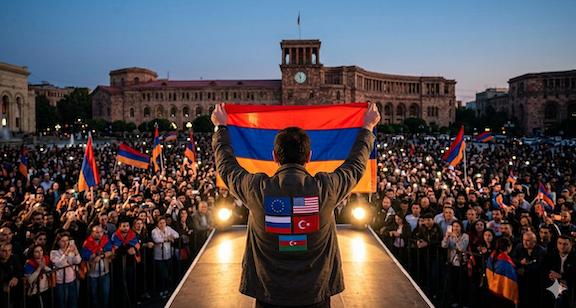
BY THE CENTER FOR ARMENIAN RESEARCH AND ANALYSIS
Ahead of the June Parliamentary elections, the Pashinyan administration is heavily marketing its campaign as an historic geopolitical awakening, pivoting away from a so-called “failing Russian alliance” toward “new Western integration.” The Pashinyan administration and its allies repeatedly define this era as a definitive step toward “true” Armenian sovereignty and independence.
This “pivot” is merely sleight of hand. Rather than building genuine state capacity, the Pashinyan regime is simply trying to replace their notion of Russian influence with straight out Western dependency and exploitation, while simultaneously allowing neighboring enemy states, Turkey and Azerbaijan, to coerce and dictate both its foreign and domestic policies.
Understanding the deception at play here requires no debate over whether Russia or the West makes a better partner for Armenia. The Pashinyan regime is presenting the potential transfer of a sphere of influence as an assertion of independence and sovereignty.
Political rhetoric that equates “Western integration” with “sovereignty” achieves neither. True sovereignty is the capacity to act without seeking foreign permission. Currently, Yerevan exercises no independence; it merely begs for a new set of permissions from Washington, Ankara, and Baku.
Trading Masters: A Pivot in Name Only
Armenia’s political establishment and public both expect and deserve a diversified and operational security posture away from sole dependency on any one state. The extent of losses in 2020 and 2023, which concluded in the largest ethnic cleansing of Armenians and the largest loss of territory since the Armenian Genocide, demonstrated the complicity of a slew of state and nonstate actors (some of them global powers) and the reluctance of yet others to intervene in these crimes against humanity.
While there may be disagreement as to the core causes of increasing Russian distance during the atrocities in Artsakh, a consensus does clearly exist that Pashinyan damaged this longstanding relationship with a series of choreographed and organized–as well as tactless and haphazard–rebuffs of Russia and the CSTO. In the meantime, Russia’s security dominance in Armenia has further waned as Armenia has paused its membership in the CSTO with Russian border guards being reduced or removed from their traditional responsibilities. Similar examples abound across both Armenian military and diplomatic spheres.
Diversification Without Deterrence
This ongoing exit from its traditional alliances and partnerships has made way for new problems in Armenia. Rather than resolving Armenia’s physical vulnerabilities, this shift has exacerbated the real dangers threatening Armenian security and sovereignty, such as border incursions, hollowed defenses, and the looming threat of large-scale aggression and escalation, to name a few. In fact, in many cases, threat levels have increased.
Armenia has, thus far, not been able to replace what it is seeking to diversify. None of the Western “strategic partnerships” and EU monitoring missions have offered a hard, kinetic deterrent against Baku or Ankara. These developments have, in no substantive way, put Armenia in a position to better prevent further territorial losses.
Plainly put, swapping a once active and dominant regional security guarantor for another potential, distant guarantor, with no treaty obligation to fight for or defend Armenian national interests, secures neither sovereignty nor safety.
A Western Pivot Funded with Russian Capital?
This strategic incoherence is further compounded by a profound economic dissonance. While the Civil Contract party touts its fiscal successes on the campaign trail, it conveniently obscures the fact that Armenia’s economic dependency on Russia has actually intensified under Pashinyan’s tenure.
Russia remains the indisputable leader in Foreign Direct Investment and the primary driver of the Armenian tourism sector, with nearly one million visitors in the last year alone. Furthermore, Armenia’s robust GDP growth remains functionally tethered to Russian capital and a lucrative “re-export” economy of sanctioned goods.
By inviting Russia’s strategic rivals into Armenia’s civic and security spheres, while remaining economically dependent on the Kremlin for energy and trade, the Pashinyan administration has increased Armenia’s fragility, providing Moscow with significant leverage that can be deployed at the moment of maximum political vulnerability.
The PR of Surrender
The administration’s surrender of sovereignty is perhaps most visible in its recurring pattern of “rebranded acquiescence.” The process follows a predictable trajectory: Baku or Ankara issues a non-negotiable demand; Yerevan initially rejects the demand for Armenian domestic (and Diasporan) consumption; the regime quietly yields to the pressure; and finally, the regime repackages the concession and sells it to the public as a “sovereign, strategic choice.”
This pattern is currently reaching its zenith in the push for so-called constitutional reform (read: fatal revisionism). The administration’s drive to remove references to Artsakh and other authentic Armenian national interests in the Declaration of Independence is not a reflection of an organic, domestic legal evolution. Instead, this move directly capitulates to Ilham Aliyev’s explicit demands, rebranded under the guise of “modernizing the state”.
Similarly, the narrative surrounding the “Zangezur Corridor” (once an immutable red line for Armenian officials) has shifted toward a proposed 99-year lease to the United States for the TRIPP route. While the Pashinyan regime markets this as a “strategic victory” over Russo-Azerbaijani pressure, it represents a generational surrender of sovereign territorial development rights to a foreign power for Turkish-Azerbaijani benefit.
The internal contradictions of this “Great Pivot” are further exposed by Yerevan’s continuous participation in the 3+3 platform. While publicly signaling a move toward Western liberal institutions, the government continued to engage in a regional format specifically designed by Turkey and Russia to exclude Western influence from the South Caucasus. To present this as “regional ownership” is a misnomer since it is an effective submission to an architectural framework dictated by Armenia’s adversaries.
Internal Strength: The Only True Guarantor
Ultimately, a state’s narrative does not neutralize threats. The distorted rhetoric and geopolitical theater of the “Great Pivot” have successfully distracted the Armenian public, yet the nation’s borders remain as porous and its statehood as precarious as they were in 2020, if not worse with incomprehensible loss of an ethnically cleansed Artsakh.
Armenia currently resembles a climber who has released his grip on one rope before securing a firm hold on the next. Until the state prioritizes the cultivation of its own internal strength – military, economic, and institutional – Armenia is not truly pivoting. Armenia merely falls into different and treacherous hands.
The Center for Armenian Research and Analysis is a trans-national institute that provides investigative, analytic, and informational resources to public and private entities across the Armenian experiential spectrum.