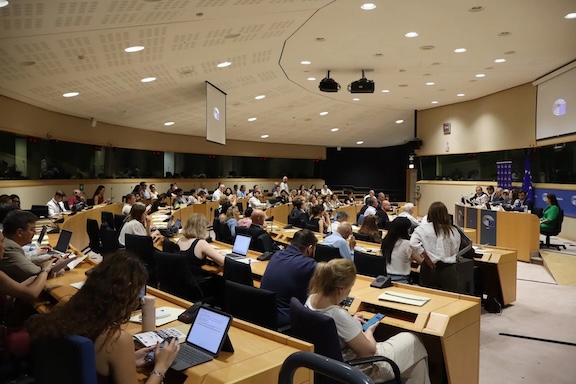
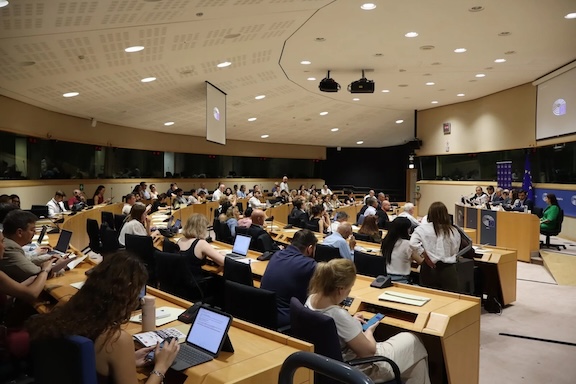
BRUSSELS — Members of the European Parliament, international human rights experts, legal practitioners, civil society representatives, and family members of Armenians imprisoned in Azerbaijan gathered at the European Parliament on Monday for a high-level conference calling on the European Union to intensify efforts to secure the immediate release of Armenian hostages and political prisoners held in Baku.
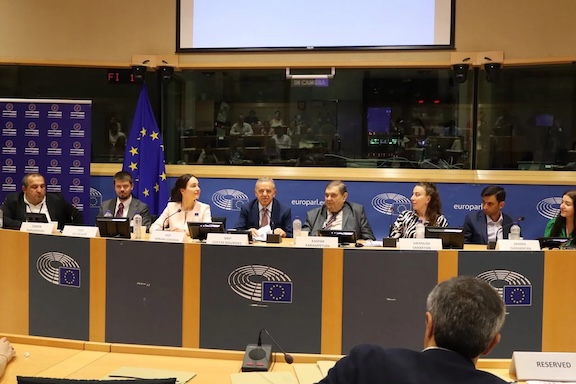
The conference, entitled “Armenian Political Prisoners in Azerbaijan and the Imperative of EU Engagement,” was co-hosted by European Parliament Members Costas Mavrides (Cyprus, S&D) and Miriam Lexmann (Slovakia, EPP), the European Parliament’s Standing Rapporteur on Armenia, and was organized with the support of the European Armenian Federation for Justice and Democracy.
Throughout the conference, speakers argued that Azerbaijan’s continued detention and prosecution of Armenian prisoners constitute not only a grave human rights concern but also a direct challenge to international humanitarian law, the international legal order, and the credibility of any future peace process between Armenia and Azerbaijan.
Members of the European Parliament Reaffirm the Parliament’s Position
Opening the conference, Costas Mavrides reaffirmed the European Parliament’s longstanding position calling for the immediate release of all Armenian detainees.
He recalled that the Parliament has repeatedly adopted resolutions demanding their release and urged the European Commission and the European External Action Service (EEAS) to implement those positions in practice. Mavrides also called for the EU’s energy relationship with Azerbaijan to be assessed through the prism of international law and human rights rather than solely geopolitical considerations.
He expressed concern that the geopolitical priorities of the EU’s executive institutions have increasingly overshadowed both the will of the European Parliament and the fundamental values upon which the European Union is founded.
Miriam Lexmann similarly argued that the European Union’s deepening partnership with Armenia should be accompanied by a much firmer policy toward Azerbaijan regarding political prisoners and Armenian hostages.
Drawing on Slovakia’s own historical experience, she emphasized that the issue of political prisoners must remain among the European Union’s highest priorities and should never become subordinate to political expediency. Lexmann also stressed that the EU possesses significant political and economic leverage through its cooperation and energy relations with Azerbaijan and should use those instruments to demand the prisoners’ immediate release.
She further underlined the importance of close coordination between Armenia and the European Union and sustained political pressure to prevent further serious violations of international law.
Families Describe the Human Cost
Representing the families of those imprisoned, Armen Ishkhanyan, the son of former Nagorno-Karabakh National Assembly Speaker Davit Ishkhanyan, described the profound personal consequences of his father’s continued detention.
He explained that his father had remained in Artsakh during the September 2023 forced displacement of the Armenian population in order to assist with the safe evacuation of civilians before being arrested by Azerbaijani authorities. He has since been sentenced to life imprisonment following proceedings widely criticized by human rights organizations as politically motivated.
Reflecting on more than one thousand days of separation, Ishkhanyan recounted a conversation with his daughter that illustrated the emotional burden carried by the families of those detained.
“When I asked her what she wanted as a birthday present, she simply answered: ‘I want my grandfather to come home.’”
He also observed that, whereas nearly every major peace agreement in modern history has included the release of prisoners of war as a first step, Azerbaijan has consistently refused to do so.
Quoting his father’s own assessment, Ishkhanyan argued that the ongoing trials in Baku are directed not only against the individual detainees but against the Republic of Armenia itself, with the prisoners effectively being used as instruments of political pressure against the Armenian state.
Legal Experts Challenge the Legitimacy of the Trials
Human rights lawyer Siranush Sahakyan, who represents several Armenian prisoners before the European Court of Human Rights, and Director of the “International and Comparative Law Center” and the “Armenian Legal Center for Justice and Human Rights,” argued that the prosecutions in Baku cannot be regarded as ordinary criminal proceedings.
She stressed that the absence of international recognition of Nagorno-Karabakh at the relevant time does not provide any legal basis for Azerbaijan’s current prosecutions.
Sahakyan noted that United Nations Security Council resolutions never declared Nagorno-Karabakh’s independence invalid or called upon states not to recognize it, unlike in certain other international conflicts.
She further recalled that, for decades, the status of Nagorno-Karabakh remained the subject of negotiations within the framework of the OSCE Minsk Group, whose representatives maintained regular contacts with the authorities of Nagorno-Karabakh—including several individuals who are now imprisoned in Baku.
Those contacts, she emphasized, were internationally accepted as part of the peace process and were never regarded as criminal conduct.
According to Sahakyan, the current proceedings therefore serve an overtly political objective: rewriting the narrative of responsibility, portraying members of the victimized and forcibly displaced Armenian population as perpetrators, and criminalizing the very political existence of Nagorno-Karabakh.
She warned that the cases carry significance well beyond the fate of the individual detainees.
“The unlawful detention and convictions of Armenian prisoners are not merely a human rights issue, but a defining test of Europe’s ability to uphold the rule of law and the international legal order,” Sahakyan said. “While the European Parliament has adopted strong resolutions, they must now be matched by effective political action. Otherwise, impunity will become the norm tomorrow.”
Calls for Concrete EU Action
Several speakers argued that expressions of concern are no longer sufficient and urged the European Union to adopt measurable political and diplomatic measures.
Simon Papuashvili, Program Director for Eastern Europe and the South Caucasus at the International Partnership for Human Rights, stated that the release of the Armenian detainees should become an explicit precondition for any credible peace process.
He proposed that the European Union establish clear benchmarks and deadlines for Azerbaijan and warned that failure to meet them should carry consequences for political dialogue, bilateral negotiations, and broader EU-Azerbaijan cooperation.
Pending the prisoners’ release, Papuashvili argued that the EU should insist upon:
- Unrestricted access for independent humanitarian organizations;
- Regular communication between detainees and their families;
- Independent medical examinations;
- Confidential access to legal counsel; and
- Full access to case files in a language understood by the defendants.
He also called for consideration of sanctions under the EU Global Human Rights Sanctions Regime against Azerbaijani officials credibly implicated in torture, arbitrary detention, or serious abuses of judicial authority.
“Peace cannot be credible while Armenian captives remain imprisoned in Azerbaijan. Their immediate and unconditional release is not a side issue but a basic humanitarian obligation and a necessary foundation for any genuine peace process. Justice, trust and reconciliation must begin with bringing every captive home safely and without delay,” said Papuashvili.
Human Rights and Europe’s Strategic Interests
Joel Veldkamp, Director of Public Advocacy at Christian Solidarity International, argued that the issue extends beyond humanitarian considerations and carries significant strategic implications for Europe.
He warned that by failing to demand the prisoners’ release, the international community risks legitimizing the use of military force to resolve conflicts and extinguish the right of peoples to self-determination.
Veldkamp criticized what he described as an increasingly unbalanced European approach to the Armenia-Azerbaijan peace process, arguing that Armenia is expected to make substantial concessions while Azerbaijan faces comparatively little pressure despite continuing to refuse to sign a final peace agreement and maintaining territorial claims against Armenia under the concept of “Western Azerbaijan.”
In his view, a stronger Armenia would serve Europe’s long-term interests, particularly in light of Turkey’s growing regional influence and the erosion of respect for international norms.
“A strong Armenia could be a helpful ally to the European Union, as it seeks to navigate an era of growing Turkish influence and weak international norms.,” Veldkamp said. “In order to empower Armenia, European policymakers would be prudent to look for ways to make the Armenia-Azerbaijan peace process less lopsided. Intervening for the twenty Armenian hostages in Baku would be an excellent place to start.”
Criticism of EU Policy
During the discussion, participants expressed concern that the European Union’s current policies do not reflect its stated commitment to human rights, noting that Azerbaijan continues to be treated as a reliable strategic partner despite the continued detention of Armenian prisoners.
Several participants questioned the persistent disconnect between the European Parliament—which has repeatedly adopted resolutions demanding the prisoners’ release—and the European Commission, which has largely refrained from translating those resolutions into concrete policy.
Mavrides remarked that, after fifteen years in the European Parliament, it has become increasingly difficult to describe the EU’s foreign policy in purely diplomatic terms.
Papuashvili also questioned the wisdom of Europe’s continued investment in fossil fuel imports from Azerbaijan, arguing that such dependence is both strategically unsound and detrimental to the European Union’s long-term energy security.
In his closing remarks, EAFJD President Kaspar Karampetian criticized what he described as the inconsistency between the European Union’s declared values and its policies toward Azerbaijan.
Referring to reports alleging that sanctioned Russian gas is being rerouted through Azerbaijan, he argued that the European Commission’s current geopolitical approach is not only morally questionable but also inconsistent with the European Union’s own legal and political commitments.
Renewed Appeal for Immediate Action
The conference concluded with a unified appeal for European institutions to move beyond expressions of concern and employ the diplomatic, political, and economic instruments available to them to secure the immediate and unconditional release of all Armenian prisoners and hostages held in Azerbaijan.
Speakers agreed that the continued detention of Armenian prisoners of war and political detainees remains one of the principal obstacles to confidence-building, accountability, and the establishment of a durable and just peace in the South Caucasus.