ARF Bureau Member Lilit Galstyan Says Azerbaijan’s Actions Exposed Failures of the International Community
08 July 2026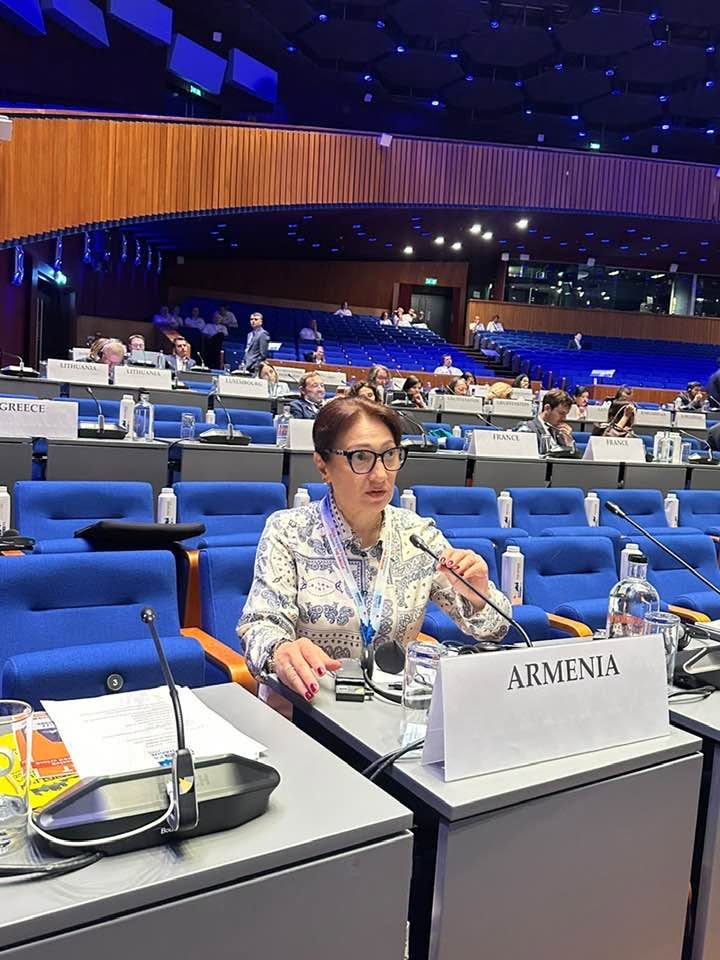
Armenia Alliance MP and ARF Bureau member Lilit Galstyan delivered her second address at the 33rd Annual Session of the OSCE Parliamentary Assembly in The Hague, warning that confidence in international law is being undermined by the selective application of legal principles and the international community’s failure to respond to serious violations.
Galstyan argued that the forced displacement of more than 120,000 indigenous Armenians from Nagorno-Karabakh and Azerbaijan’s actions exposed the shortcomings of the international community’s response, emphasizing that international law must not become subject to political bargaining or selective enforcement.
She said Azerbaijan has repeatedly ignored international conventions and binding decisions issued by international courts over the past six years, including rulings calling for the lifting of the blockade of Nagorno-Karabakh, the safe return of the displaced population, the protection of Armenian cultural heritage, and accountability regarding the ongoing trials of former Artsakh political and military leaders.
Galstyan concluded by calling on the international community to reaffirm that international law is non-negotiable and that its principles must be applied consistently.
Below are her full remarks:
Dear colleagues,
In this city of peace and justice, we are having a debate on one of the most discussed issues internationally.
I have to be frank, many in my country question the reputation of law and the credibility of the international order itself.
But international law does not weaken overnight. It is weakened every time violations go unnoticed. Each time political convenience prevails over legal obligation, or we apply standards selectively.
The growing distance between our commitments and the choices we make should concern us all.
How can we claim to be defenders of democracy, security and peace when we are surrounded by wars, when, by conducting a policy of double standards, we refuse to acknowledge violations, while the gap between our commitments and reality continues to widen dramatically?
It is not easy to speak about shared values and principles in today’s geopolitical environment when we are witnessing the continuous erosion of those very values.
The forced displacement of more than 120,000 indigenous Armenians from Nagorno-Karabakh did not happen because international law was absent. Azerbaijan’s aggression and the subsequent ethnic cleansing revealed the inadequacy of our collective response.
Over the past six years, Azerbaijan has repeatedly ignored international conventions and resolutions, including binding decisions of international courts calling for the immediate lifting of the blockade, ensuring the safe return of the displaced indigenous population, condemning the destruction of Armenian cultural heritage, and addressing the ongoing sham trials of the former political and military leaders of Artsakh.
Dear colleagues, it is absolutely evident that credibility is eroded when principles and regulations are not defended and violations are met with silence.
Let us reaffirm that international law is not negotiable, and shared principles are not optional.
Our principles are only as strong as our willingness to defend them.