Remarks by ARF Bureau Member Daron Der Khachadourian at the Event Dedicated to May 28 in London
22 June 2026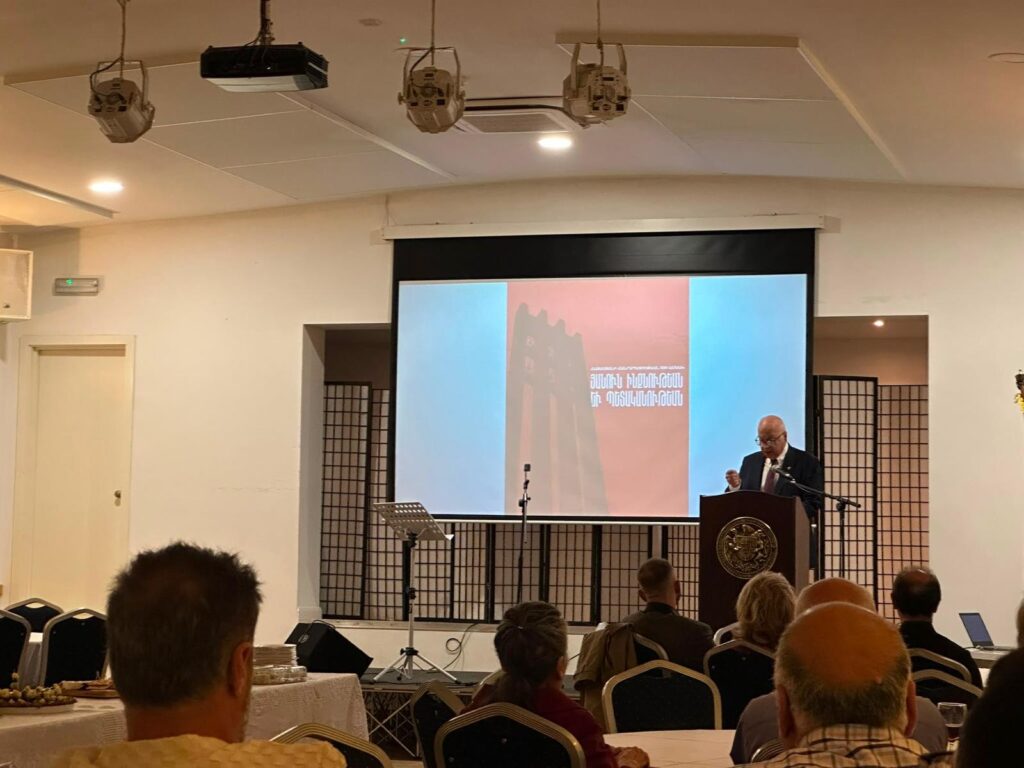
On June 20, a celebration marking the anniversary of the First Republic of Armenia and May 28 was held at the Navasartian Centre in London, organized by the ARF London Darbinian Gomideh. ARF Bureau member Daron Der Khachadourian attended the event as the keynote speaker and delivered remarks reflecting on the significance of May 28, the challenges facing the Armenian nation today, and the responsibilities of Armenians in the Diaspora and homeland alike.
The following are the full remarks delivered by Daron Der Khachadourian at the event:
Ladies and Gentlemen,
Today we commemorate May 28, 1918, one of the most consequential dates in Armenian history. On that day, after centuries without statehood, the Armenian people restored their independence and re-entered the family of nations. May 28 was not merely the proclamation of independence; it marked the birth of the modern Armenian nation-state.
Armenia is an ancient civilization whose history stretches back thousands of years. Armenians possessed kingdoms, a distinct culture, and a strong state tradition long before many modern nations existed. Yet the modern world was shaped by the principle of national self-determination—the idea that every people has the right to govern itself through its own state. As empires gradually gave way to nation-states in Europe and elsewhere, Armenians too sought to reclaim their political sovereignty.
The establishment of the First Republic of Armenia in 1918 represented the realization of that aspiration. It transformed Armenians from a people defined only by history, culture, and faith into a modern political nation with a government, institutions, and a claim to international recognition. In a world where thousands of ethnic groups exist but only a limited number have sovereign states, Armenia’s place among the nations remains a historic achievement.
The road to May 28 was long. For centuries after the fall of Ani and later the Armenian Kingdom of Cilicia, generations of Armenians preserved the dream of restoring statehood. Intellectuals, merchants, church leaders, and national figures across the Armenian world kept alive the idea that the Armenian nation should once again become master of its own destiny.
A decisive chapter in that struggle came during the final years of the Ottoman Empire. Armenian national aspirations stood in direct conflict with the rising Turkish nationalist vision that sought to create a homogenous state across lands where Armenians had lived for millennia. The Armenian Genocide of 1915 was therefore not only a humanitarian catastrophe; it was also an attempt to eliminate the possibility of Armenian political existence.
Yet history did not end in 1915. Against overwhelming odds, Armenians resisted. The battles of Sardarabad, Bash Abaran, and Karakilisa saved the Armenian people from complete destruction and created the conditions for independence. Sardarabad, in particular, occupies a unique place in our national memory because it was there that the survival of the Armenian nation as a political entity was secured.
The Armenian Revolutionary Federation played a central role during these critical years. Its leaders, volunteers, and military commanders helped organize resistance, defend the population, and lay the foundations of the First Republic. Whatever one’s political views, the contribution of that generation to Armenian statehood remains undeniable.
The significance of May 28 extends beyond the past. It continues to shape how Armenians understand contemporary challenges, including the struggle of the Armenians of Artsakh. For many Armenians, the question of Artsakh has been linked to the principles of self-determination, security, and national survival. The tragic displacement of the Armenian population of Artsakh has reinforced the lesson that statehood and political power remain essential safeguards for a nation’s collective existence.
These concerns are also reflected in current political developments in Armenia. In my remarks today, I expressed serious concerns regarding the June 7 elections and the direction of the country’s leadership. Many Armenians believe that the elections did not fully meet the standards of fairness, transparency, and equal political competition that are essential to a healthy democracy. There is also deep concern that some of the policies pursued in recent years have weakened Armenia’s national position at a time of extraordinary geopolitical and security challenges. Regardless of political affiliation, however, the central issue remains the same: Armenia needs leadership that places national security, sovereignty, historical rights, and the long-term interests of the Armenian people at the forefront of public policy. Governments may come and go, but national interests endure.
At the same time, May 28 reminds us that the Armenian people are far more than the borders of any single state. The Armenian Diaspora, born out of tragedy, became one of the most organized and resilient diasporas in the world. For generations it preserved Armenian identity, defended historical memory, supported Armenia and Artsakh, and built vibrant communities across the globe. The future of the Armenian nation depends upon maintaining a strong partnership between Armenia and the Diaspora, recognizing that they are two inseparable components of one national whole.
Our history also teaches us important lessons about ourselves. Armenians have demonstrated remarkable resilience, creativity, and determination. We have survived genocide, exile, and repeated attempts at eradication while preserving our language, faith, and culture. We have repeatedly shown courage in moments of existential danger. Yet we must also acknowledge our weaknesses, particularly internal divisions and the tendency at times to place personal or factional interests above collective national goals. Unity does not require uniformity; it requires a shared commitment to the nation’s fundamental interests.
Finally, let me emphasize that Armenians are not opponents of peace. On the contrary, we seek a peacefounded upon justice, mutual respect, and recognition of fundamental rights. Durable peace cannot be built upon force, denial, or injustice. It must be based on truth, dignity, and security for all peoples. That is the kind of peace Armenians seek—not only for themselves, but for the entire region.
May the spirit of Sardarabad continue to inspire us.
May May 28 remind every Armenian of the value of freedom, statehood, and national responsibility.
Long live May 28.
Long live the independent Armenian state.
And long live the Armenian people