Right to Return, Right to Know, Right to Reparations
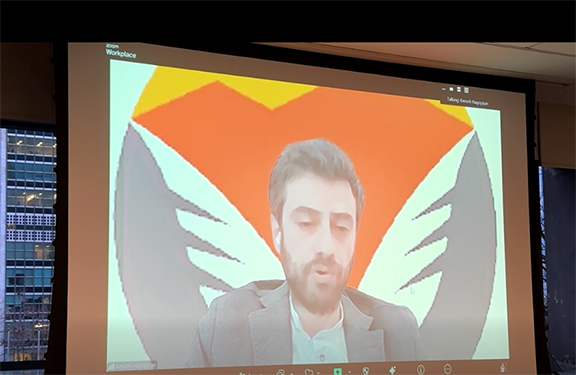
24 May 2026 BY DR. KEVORK HAGOPJIAN, ESQ.EDITOR’S NOTE: Dr. Kevork Hagopjian, Esq. made a presentation on March 17 at a United Nations panel entitled “From Displacement to Justice: Strengthening Protection, Rights and Recovery for Conflict-Affected Women and Girls.” Speaking on behalf of the Armenian Legal Center for Justice and Human Rights, Hagopjian highlighted the plight of Artsakh women who were forcibly displaced in 2023.
Below is Dr. Hagopjian’s presentation
A Legal Crisis in Plain Sight
Distinguished panelists, honored delegates,
Imagine waking up one morning to find that the legal architecture meant to protect you — international humanitarian law, CEDAW, the Guiding Principles on Internal Displacement or refugees — exists in full, on paper. And yet you are homeless. Your husband is a prisoner of war in a foreign country. You do not know whether he is alive. Your house has been destroyed, your land confiscated, and there is no court for redress.
This is not a hypothetical. This is the lived legal reality of tens of thousands of indigenous Armenian women from Nagorno-Karabakh — Artsakh — who were displaced, forcibly displaced, in September 2023. More than 150,000 ethnic Armenians fled within days. More than half of them were women and girls.
The Armenian Legal Center for Justice and Human Rights — ALC — pursues accountability for victims of this conflict through international legal mechanisms. Today I want to speak from that legal vantage point: not only to describe suffering, but to name the specific legal obligations being violated, with precise figures, and to argue that this Commission must treat access to justice not as an aspiration, but as an enforceable standard.
Three Rights, Three Failures — With Numbers
The CSW70 priority theme asks us to eliminate structural barriers to justice. Allow me to name three structural failures where international law is clear, obligations are binding, and the gap between law and reality is measurable.
The Right to Know — Missing Persons and Enforced Disappearance
Under the Geneva Conventions and their Additional Protocols, all parties to an armed conflict have a binding legal duty to search for missing persons, provide information about their fate and whereabouts, and facilitate the return of remains. When states fail this obligation, the families of missing persons — overwhelmingly mothers, wives, and daughters — suffer a continuing violation of their own rights: to family life, to be free from cruel treatment, and to an effective remedy.
Here are the numbers behind that legal failure:
429 persons still missing from the 2020 war and subsequent hostilities — ICRC tracing requests, 2020–2023
195 additional missing from the September 2023 offensive alone — International Commission on Missing Persons, September 2024
777 missing from the first Karabakh war — still unresolved after three decades — ICMP Armenia report, September 2024
That is more than 1,400 people whose fate is unknown to their families across the two Karabakh wars and the 2023 displacement. Behind each number is a mother, a wife, a daughter waiting — in some cases for thirty years. This is not a bureaucratic gap. It is a continuing legal violation, recognized as such under the International Covenant on Civil and Political Rights, the jurisprudence of the ECHR, and CEDAW General Recommendation 30.
ALC, together with partner organizations, has submitted cases before the UN Working Group on Enforced or Involuntary Disappearances and engaged the ECHR precisely because the right to know is not a political courtesy — it is a justiciable right. When legal channels fall silent, women bear the burden alone.
POWs, Detainees, and the Weaponization of Legal Categories
International humanitarian law is clear: prisoners of war must be treated humanely, granted family contact, monitored by neutral actors, and repatriated after active hostilities. These are not aspirational standards — they are binding obligations under the Third Geneva Convention.
What has happened in practice is a systematic legal reclassification that transforms these protections into bargaining chips. Consider the trajectory of acknowledged detainees:
72 Armenians acknowledged in custody — ECHR/Committee of Ministers notification, March 2021
23 acknowledged in custody — four years later — ECHR update request, October 2025
19 confirmed held today, after the January 2026 release — post-swap baseline, January–February 2026
These declining numbers might appear to indicate progress. They do not. They reflect a deliberate legal strategy: from February 2021 onward, Azerbaijani officials publicly claimed there were “no POWs left” — reclassifying remaining Armenian detainees as criminal suspects. Criminal cases were opened against more than sixty Armenian POWs and civilians, with short and sham trials, heavy sentences, and releases tied explicitly to negotiations rather than to legal standards.
Critically for this panel: the ICRC ended its physical presence in Azerbaijan in September 2025. The one organization with a mandate to conduct confidential detention monitoring — to be the neutral actor guaranteed by IHL — is no longer there. Families of the 19 confirmed remaining detainees now have no independent monitor, no confidential channel, no eyes inside those facilities. This is the worst possible moment for the international community to look away.
The Right to Return and Reparations — Justice as a Matter of Geography
The right of displaced persons to voluntary, safe and dignified return is enshrined in the Guiding Principles on Internal Displacement and in CEDAW General Recommendation 32 on gender-responsive approaches to displacement. Housing, land and property restitution is a core component of reparations under the UN Basic Principles on the Right to a Remedy.
For Artsakh women displaced to Armenia and third countries, none of these rights have a functional mechanism attached to them. There is no restitution process, no property claims body, no international monitor with physical access to the territory.
There is also the dimension of torture and secondary victimization that the UN Committee Against Torture shadow report of March 2024 places squarely on the table: families described as ‘secondary victims,’ harmed by public humiliation videos, uncertainty, and threats. The report documents abuse from capture through transport to closed detention. Impunity for perpetrators — in some cases, their glorification — is itself a form of ongoing harm to women who wait for information.
From Documentation to Adjudication: What ALC Does
The ALC’s work proceeds from a conviction that international legal mechanisms — imperfect as they are — remain essential tools for communities who have no army, no territory, and no state resources to compel accountability. Let me describe three dimensions of our work directly relevant to this panel.
Documentation as a Legal Foundation
Legal accountability begins with evidence. ALC conducts systematic documentation of violations committed against indigenous Armenians across the 2020 war, the 2022–2023 blockade, and the September 2023 displacement. Our documentation includes survivor testimony, open-source intelligence, satellite imagery, and forensic methods recognized by international tribunals.
Trauma-informed documentation that centers the experience of women survivors is not a methodological preference — it is a legal imperative, recognized by the ICC Policy on the Crime of Genocide and its framework for gender-based crimes.
Strategic Litigation — International and Regional Courts
ALC has been engaged in supporting ECHR proceedings on behalf of Armenian POWs, civilian detainees, and displaced persons. The ECHR’s Rule 39 interim measures framework has been invoked repeatedly to seek information about detainees’ fate and to demand safeguards — because without that pressure, ‘acknowledged’ numbers would be even harder to obtain.
The UN System — Advocacy and Treaty Body Engagement
ALC engages with Universal Periodic Review submissions, Special Procedures communications, and treaty body reviews. We submitted to the UN Working Group on Enforced or Involuntary Disappearances, highlighting how video evidence of captives in custody can coexist with official denial of their detention — a perverse but legally significant dynamic.
We have called for the CEDAW Committee to exercise its inquiry procedure under Article 8 of the Optional Protocol where there is evidence of grave or systematic violations. The Special Rapporteur on IDPs, the Working Group on Disappearances, and the Special Rapporteur on Torture all have active mandates with direct application to what is described in this room. Their engagement is not optional — it is required.
Four Calls to This Commission
This Commission has the opportunity — and the responsibility — to produce agreed conclusions that close specific accountability gaps. On behalf of ALC, we urge the following:
First: Name POW families and families of the missing explicitly.
The agreed conclusions must recognize that women who are family members of missing persons, POWs & hostages, and disappeared individuals suffer distinct, continuing violations. With over 1,400 persons missing across the Karabakh conflicts and 19 confirmed hostages still held — with no independent monitor present since ICRC’s departure in September 2025 — this Commission cannot afford generic language. States must be called upon to implement IHL obligations on missing persons and detainees as legal duties, not as political choices.
Second: Condemn the weaponization of legal categories.
The practice of reclassifying POWs and hostages as criminal suspects to extend detention and extract political concessions must be named as a violation of IHL and international human rights law. The agreed conclusions should affirm that domestic criminal proceedings cannot substitute for compliance with POW repatriation obligations under the Third Geneva Convention.
Third: Integrate the right to return into gender-responsive justice frameworks.
Displaced women’s access to justice requires legal recognition of housing, land and property rights that are independent of documentation gaps caused by the displacement itself. The agreed conclusions should call for accessible, gender-sensitive property claims mechanisms and for international support for legal aid to displaced populations.
Fourth: Address the monitoring vacuum and Call for the immediate and unconditional Release of POWs and Hostages.
The ICRC’s departure from Azerbaijan in September 2025 creates a dangerous monitoring gap. This Commission should call on states to facilitate the immediate restoration of independent detention monitoring — and on the relevant state to grant the ICRC and other neutral actors unobstructed access, as required under IHL. No monitoring means no protection. What would be even more important is to call for the immediate and unconditional release of all remaining POWs and hostages.
Justice Is Not Patience
“States are not permitted to remain passive in the face of the suffering of victims of serious violations of international law.” — Inter-American Court of Human Rights, Velásquez Rodríguez
The women of Artsakh did not choose displacement. They did not choose to have their husbands taken as prisoners of war and hostages, their names entered into a missing persons database, their properties confiscated, their right to return suspended indefinitely in the corridors of geopolitics. They chose to survive. And survival, when the legal system functions as it should, is the beginning of a claim — not the end of one.
Today, 19 men remain confirmed in Azerbaijani custody — several with life sentences handed down just weeks ago. More than 1,400 families do not know the fate of their loved ones. There is no functioning restitution mechanism for the property lost by 150,000 displaced Armenians. And the one neutral body mandated to monitor detention has been absent since September 2025.
These are not abstract legal failures. They are the daily reality of women in Armenia and in diaspora communities around the world — women who come to organizations like ours not because they believe in the perfection of international law, but because they believe that the alternative to accountability is silence, and silence is what perpetrators prefer.
ALC will continue to file cases, submit reports, document violations, and argue before every available forum until these obligations are met. We ask this Commission to share that commitment — in the agreed conclusions, in the follow-through, and in the political will to treat women’s access to justice as a non-negotiable foundation of the international order this institution was created to defend.
The women of Artsakh are here. Their cases are filed. The law is on their side. What they need is for this Commission to be on their side too.
Thank you.