The Artsakh Weekly Report
16 August 2026 Baku Appeals Court Seals Hostage SentencesLemkin Institute Backs Women's Delegation to Baku
Yerevan Abandons Freed POW-Hostage Euljekjian
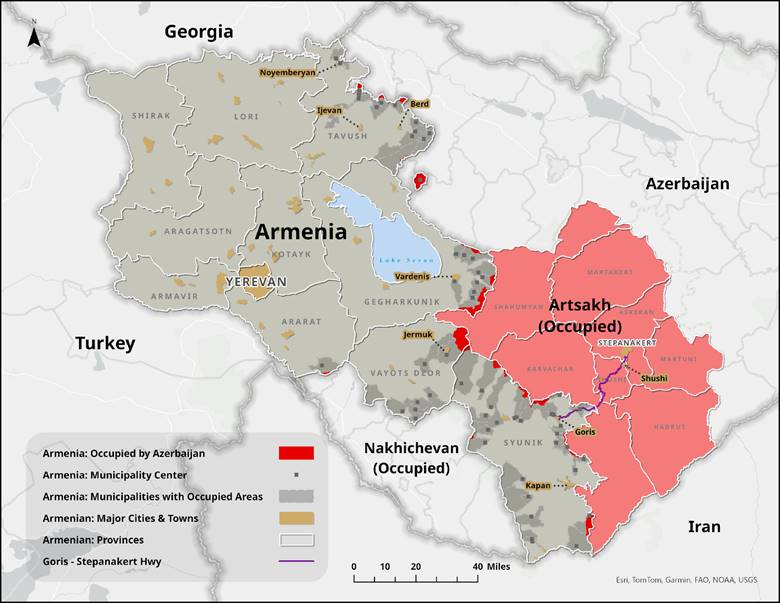
The Center for Armenian Research and Analysis (CARA) gathers and analyzes critical information on activities occurring in occupied Artsakh by state and non-state actors, and produces a weekly brief, with actionable data, to public and private stakeholders. Keeping Artsakh alive and in the public consciousness is part and parcel of CARA’s mission of providing clear and unfettered research and analysis pertaining to indigenous Armenian rights and cultural survival.
TOP ARTSAKH HEADLINES, AUGUST 3-9, 2026
Baku Appeals Court Rubber-Stamps Life Sentences for Artsakh’s Leadership
On August 6th, the Baku Court of Appeals rejected the appeals of the former leadership of Artsakh (Nagorno-Karabakh) and other Armenian hostages, leaving the convictions and sentences of Azerbaijan’s show trials in place. Life sentences stand for former Artsakh President Arayik Harutyunyan, former Defense Army Commander Levon Mnatsakanyan, former Deputy Commander Davit Manukyan, Parliament Speaker Davit Ishkhanyan, and former Foreign Minister Davit Babayan. Twenty-year terms stand for former Presidents Arkadi Ghukasyan and Bako Sahakyan and former State Minister Ruben Vardanyan — spared life imprisonment not by any finding of the court, but because Azerbaijani law bars life sentences for defendants aged 65 or older. Eight more Armenian hostages had sentences of 15 to 19 years confirmed. The ruling exhausts the pretense of domestic appeal and confirms what Armenian and international rights advocates have said since these sham trials began: the proceedings are political instruments, and the men in the dock are hostages of the Azeri state that emptied their homeland of its indigenous population. (Sources: Armenian Report Article, Armen Press Article, AzerNews Article, Horizon Weekly Article, Asbarez Article, Hetq Article)
Azeri Mouthpiece Denies Artsakh’s Ethnic Cleansing Under Cover of “Multiculturalism”
Writing in AzerNews, Ulviyya Poladova claimed that accusations of Azerbaijan’s “expulsion of Armenians from Artsakh (Nagorno Karabakh)” are “politically motivated propaganda designed to distort reality,” and that “Baku’s priority has always been the restoration of its territorial integrity.” She pointed to the so-called “reintegration proposal” Baku advanced in 2023, which she claimed “invited Armenians to remain as equal citizens with fully protected cultural and religious rights,” and further claimed the subsequent “departure” of the entire Armenian population was voluntary because residents were not forced to leave and could have remained under Azerbaijani sovereignty. Armenian authorities, she wrote, have labeled that departure as “ethnic cleansing,” a characterization that the genocidal state of Azerbaijan firmly rejects. Azerbaijan, she asserted, is a “multiethnic and multicultural space housing Christians and Jews,” unlike what she called Armenia’s largely mono-ethnic state. This is genocide denial in the register of a diversity brochure. It asks the reader to accept that more than 120,000 forcibly displaced, ethnically cleansed indigenous Armenians of Artsakh chose exile — after a nine-month blockade, a military assault, and the dissolution of their republic — rather than accept citizenship from the state that had just starved, shelled, and murdered them while still destroying their millennial indigenous culture and sacred sites. (Source: AzerNews Article)
Yerevan Cites “Daily Efforts” as 19 Armenian Hostages Remain in Baku
Newly elected Speaker of the Armenian Parliament, Ruben Rubinyan, claimed that the Armenian government “works daily to secure the return of Armenian prisoners of war held in Azerbaijan.” Rubinyan further rationalized state passivity in the matter of POWs by claiming that “negotiations pass through long periods without visible progress,” and took credit for Armenian state efforts for the repatriation of more than 200 prisoners over the years. Nineteen Armenian hostages remain unlawfully held on fabricated charges, among them the former leadership of Artsakh. These “assurances” by the Armenian state representative appear in the same weekly record as an open letter from a coalition of rights organizations accusing the Armenian government of abandoning a hostage whose release it had already secured. (Source: Armen Press Article)
Azeri NGOs Move to Preempt the Armenian Case at the UN Disappearances Committee
Azeri civil society organizations have filed fabricated reports with the UN Committee on Enforced Disappearances ahead of its 31st session slated for September 2026, alleging that Armenia’s second periodic report fails to address the fate of Azerbaijani prisoners, hostages, and missing persons from the First Artsakh (Nagorno-Karabakh) War. The International Eurasia Press Fund and other Azeri front groups submitted filings on the enforced disappearance of Azerbaijani children and adults and plan to brief committee members directly in Geneva. Azerbaijan’s State Commission claims the number of Azerbaijanis officially missing at 4,005 as of May 2026, of whom 3,999 are purportedly attributed to the First Artsakh War — 3,224 military personnel and 781 civilians, including 71 children, 287 women, and 319 elderly people.
These maneuvers, actually, invert the true record at precisely the forum where it is most likely to be tested. By certain official reports, at least 80 Armenians have been forcibly disappeared and more than 200 more remain unaccounted for, however, NGOs, human rights groups, and researchers place the number far higher. Azerbaijan continues, unabashedly, to ignore its obligations to investigate or acknowledge those cases, while fabricating absurdly high numbers for Azeri missing persons. Baku’s mobilization of its own NGO sector should be read as an effort to occupy the committee’s attention before a thorough accounting can be demanded of it. It is, also, important to note that during the Artsakh Self Defense War (First Nagorno Karabakh War) confirmed report littered the media landscape describing how Azeri authorities, particularly special military and intelligence units, were notorious for killing, torturing, and disappearing their own in the theater of battle and in civilian scenarios when their own forces refused to fight or would retreat. (Source: Article)
Taleb Boycotts Baku Over Vardanyan — and Baku’s Defenders Answer by Smearing the Hostage
The boycott. The Lebanese American philosopher Nassim Nicholas Taleb declared on the social media platform X that he refuses to lecture in Baku while Ruben Vardanyan — the former Artsakh state minister and philanthropist — remains illegally imprisoned there. Noubar Afeyan, the American Armenian businessman, founder and CEO of Flagship Pioneering, and co-founder of Moderna, publicly thanked Taleb for his “principled stance.” The gesture is simple and it is the reason it stung: a scholar of international standing declined to lend his presence to a state holding a hostage.
The response. On August 5th, Ergun Kirlikovali — a Turkish-American scientist and engineer known for developing advanced materials for the U.S. Navy and Air Force — published an open letter attacking Taleb’s position. Kirlikovali argued that Taleb, known for analyzing risk and systemic vulnerability, should apply that scrutiny to Vardanyan’s “actual background” rather than accept his public image as a philanthropist. Rather than contest the illegality of the imprisonment, however, Kirlikovali changed the subject, filling his letter with irrelevant claims meant more to distract the reader than to answer the charge. He described Vardanyan’s 2022 move to Artsakh and subsequent arrest as part of “broader regional security developments”; cited the illegal 20-year sentence handed down by a sham Baku Military Court in February 2026 for supposedly “financing terrorism and creating illegal armed groups,” charges Vardanyan vehemently rejects; and faulted the lack of international attention to Azerbaijani civilian victims, invoking the displacement of Azerbaijani residents and the so-called “Khojaly tragedy.” “True humanity,” he claimed, means standing with victims of “displacement and aggression rather than with powerful financiers.”
The tactics. The letter answers nothing Taleb actually said, and its construction is worth naming, because it is the standard kit.
- Substitute the man for the question. Taleb’s objection is that a civilian is imprisoned after proceedings widely condemned as political. Kirlikovali does not defend the proceedings; he attacks the prisoner’s character. The subject is changed rather than met.
- Guilt by financial association. The “Troika Laundromat” material concerns a firm and is unrelated to anything Baku charged. Vardanyan was convicted of purportedly financing terrorism and forming armed groups — not of laundering. The offshore allegations are imported precisely because the conviction cannot carry the argument on its own.
- Launder the verdict. The February 2026 sentence is cited as though it were a finding of a competent court, when that proceeding is the very thing in dispute. The court is offered as evidence for its own legitimacy.
- Neutralize the abduction. A hostage-taking becomes “broader regional security developments” — the passive geopolitical register in which no one does anything to anyone.
- Borrow unrelated authority. The letter opens on credentials in military materials science, a field with no bearing whatsoever on the case.
- Invert the victim. The pivot to supposed Azerbaijani civilian suffering and the projected “Khojaly tragedy” is not offered as additional grief, but as displacement of the subject — deployed by the side that emptied Artsakh of its entire indigenous population in 2023, in defense of the authoritarian and genocidal state now holding its leaders. (Sources: News.am Article, Kirlikovali Letter, News.az Article)
Zonabend Presses for Access to Armenian Hostages as Lemkin Institute Backs Women’s Delegation
On July 31st, Veronika Zonabend — wife of imprisoned philanthropist and former Artsakh State Minister Ruben Vardanyan — issued a statement on a dedicated website, www.freearmenianprisoners.com, marking 100 days since her husband’s transfer to the Umbaki Penitentiary Complex. Vardanyan has illegally been held in Baku since September 2023 and has not once been permitted to see his family in person. Having received no response whatsoever to her earlier appeals, Zonabend wrote again on July 30th to Azerbaijan’s Commissioner for Human Rights, Sabina Aliyeva, and to Armenian Prime Minister Nikol Pashinyan, regarding an international women’s humanitarian delegation to Baku.
The initiative is strictly humanitarian: to visit Armenian hostages, deliver personal letters, photographs, and permitted family parcels, and help the illegally detained, tortured, and medically neglected men keep contact with their families. Zonabend requested Aliyeva’s office to facilitate access to Umbaki prison and to guarantee the delegation’s safe entry, stay, and unhindered departure, offering to proceed with the full delegation, a smaller group, or a group accompanied by an official escort, provided the format permits direct humanitarian contact. She also asked Armenia’s Prime Minister Pashinyan to designate an official to coordinate the initiative.
Zonabend first proposed the mission in May 2026. Until this week, not one humanitarian or rights organization had responded. The Lemkin Institute for Genocide Prevention has now given it full support, urging the United States, Canada, the United Kingdom, the European Union, and EU member states to use their diplomatic presence in Azerbaijan to guarantee the safety of Zonabend and the other participating women, and calling on rights advocates and international organizations to back the basic right of these families to visit their illegally imprisoned relatives — demonstrations of humanity the Institute called crucial to saving the hostages and to combating “accelerating evil in the world.” That the wives and mothers of hostages must organize their own prison visit, and wait from May until August for a single institution to answer, is itself a measure of the abandonment surrounding these illegally held and imprisoned hostages. (Sources: Armenian Mirror-Spectator Article, Asbarez Article)
Rights Groups: Yerevan Abandoned Freed POW-Hostage Vicken Euljekjian
An open letter from a coalition of Armenian and international civil society organizations, led by the Montreal-based Aghmoog Collective and including the Lemkin Institute for Genocide Prevention and Human Security, has denounced the Armenian government’s failure to provide rehabilitation, medical and psychological care, housing, and social support to repatriated Armenian hostages. The coalition builds its case on Vicken Euljekjian, abducted by Azerbaijani forces on November 10, 2020, after the Second Artsakh (Nagorno-Karabakh) War ceasefire and released in January 2026 after more than five years in captivity.
On January 14, 2026, four Armenian hostages — Gevorg Sujyan, Davit Davtyan, Vicken Euljekjian, and Vagif Khachatryan — were released. Before any thorough medical or forensic evaluation, Prime Minister Nikol Pashinyan declared that all but Khachatryan had “no health issues” and called Khachatryan’s condition “satisfactory,” while the National Security Service framed the release as part of an “established peace process.” The rights groups argue this legitimizes Azerbaijan’s hostage-taking as a bargaining tool, particularly as the release coincided with Armenia’s extradition of two Syrian nationals convicted of mercenary activity and international terrorism. It also contradicts Yerevan’s own submission to the UN High Commissioner for Human Rights of March 11, 2025, which explicitly acknowledged “signs of torture” and “evident deterioration of health” among Armenian detainees held by Azerbaijan.
Euljekjian has since been diagnosed with Group III disability, multi-level cervical and lumbar spine degenerative-dystrophic changes producing severe mobility impairment, bilateral moderate-to-severe sensorineural hearing loss, and arterial hypertension. The Armenian government has not covered his treatment. After six months of appeals, the Ministry of Labor and Social Affairs produced a bathroom chair, two hearing aids, and a monthly benefit of 46,000 AMD — roughly $125. By May 2026, he was homeless in Yerevan. Rather than shelter him, Armenian state officials circulated false claims that he had refused state assistance; inquiries to Minister of Labor and Social Affairs Arsen Torosyan and High Commissioner of Diaspora Affairs Zareh Sinanyan went unanswered. Grassroots campaigns, not the state, secured his temporary housing and paid his travel to reunite with his daughter.
The coalition demands a victim-centered rehabilitation process, emergency social and financial assistance, permanent housing, full compensation of medical expenses and losses from captivity, a reassessment of his disability status to international standards, an official retraction of the false allegations — including the harm caused by state-backed bodies such as the Soldier’s Home Foundation — and an end to the politicization and tokenization of released hostages. Failing action, the coalition warns it will pursue remedies before international human rights mechanisms. (Source: Armenian Report Article)
“On the Ground” in Occupied Artsakh
Azeri Demining Agency Claims 8,000 Hectares Cleared Across Occupied Artsakh
Azerbaijan’s National Agency for Mine Action reported clearing 8,012.7 hectares across occupied Artsakh during July, in operations it said spanned occupied Akna (Aghdam), Berdzor (Lachin), Kovsakan (Zangilan), and Stepanakert, along with the occupied Tartar and Varanda (Fizuli) districts, supposedly locating and neutralizing 614 anti-personnel mines, 174 anti-tank mines, and 2,106 pieces of unexploded ordnance. The figures are Baku’s own and cannot be independently verified and are published by the Azeri state to anchor their false narrative that Artsakh’s occupied and ethnically cleansed territories are a “humanitarian theater” rather than the site of genocide, and to, than also, underwrite the programmatic Azeri settlement program that follows the clearance. (Source: ANAMA Report)
Two Deminers Wounded in Blast in Occupied Maghavuz
On August 3rd, at around 10:40 AM, an NGO employee triggered an anti-personnel mine during a demining operation in the occupied village of Maghavuz (Chardagly) in occupied Martakert (Aghdara), injuring two deminers. Alzamin Surkhayli, born 1994, who triggered the mine, suffered a traumatic amputation of his right ankle joint and is being treated at the Tartar Central District Hospital and is said to be in moderately serious condition. Fuzuli Mirzayev, born 1998, sustained multiple shrapnel wounds to the anterior abdominal wall and was evacuated to the Barda Central District Hospital. (Source: Mine Incident)
Azeri Veterans’ Organization Demands International Pressure on Armenia Over Mine Maps
On August 4th, the Organization of War, Labor and Armed Forces Veterans of Azerbaijan “appealed” to the international community over what it termed as “the mine problem,” claiming Armenia has waged “mine terrorism” for more than thirty years and that landmines continue to claim lives despite the end of the 44-day war and the initialing of a so called “peace text.” The organization asserted that mines obstruct development, construction, and “resettlement” in occupied Artsakh and undermine what it called a newly formed atmosphere of trust, claiming Armenia’s refusal to hand over maps of mined areas is the principal obstacle, and called on world states to provide financing, supply modern clearance technology, and exert serious pressure on Armenia to release the maps. This campaign’s actual function is to convert the physical difficulty of illicitly settling the depopulated and ethnically cleansed territories of Artsakh into a grievance against the very people were driven out of their indigenous homeland and against whom cultural genocide by Azerbaijan still continues. (Source: Appeal to the International Community)
More Than 100 Azeri Settlers Moved into Occupied Martuni
On August 5th, yet another group of illegal Azeri settlers was deployed by Azerbaijani authorities into occupied Martuni (Khojavand) in Artsakh— 27 families totaling 107 people, were presented with keys to new houses, on arrival, by state representatives. Twenty families, 81 people, were placed in occupied Martuni city; two families, 9 people, in the occupied settlement of Karmir Shuka (Girmizi Bazar); and five families, 17 people, in occupied Martuni village. Citing supposed safety concerns, Azerbaijan’s National Agency for Mine Action briefed the arrivals on the dangers of mines and unexploded ordnance. Officials from the State Committee for Affairs of Refugees and IDPs, the Special Representation of the President of Azerbaijan, and the local Restoration, Construction, and Management Service attended the ceremonies. These are indigenous Armenian villages, emptied of their inhabitants in September 2023 and now being settled and repopulated, family by Azeri family, with keys to homes handed over at welcoming ceremonies as part of Azerbaijan’s growing “Settlers Offensive,” a sinister part of their program of erasure of indigenous Armenians, their culture, and heritage. Experts say the “Settler Offensive” is based on Israeli models and algorithms. It is important to note Israeli intelligence and military advisors and specialists have been directly involved, to a great degree and and numbers, in a variety of Azeri state and private sector areas, particularly in the intelligence and defense communities. (Sources: Relocation to Occupied Khojavand, Caliber Article)
Baku Advertises Occupied Akna Industrial Park as Proof of a “Self-Sustaining” Occupation’s Offensive
Azeri sources report that companies in the so-called “Aghdam Industrial Park,” in occupied Akna, recorded AZN 976 million (USD 574.12 million) in product sales in the first half of 2026, including AZN 42 million (USD 24.71 million) in exports, with investors supposedly committing more than AZN 177 million (USD 104.12 million) and 1,230 permanent jobs generated. According to Azeri state sources, the “park” is said to host 12 operating enterprises, with 12 more under construction and 10 in planning, with roughly 60% of its territory allocated. It is, according to these same Azeri sources, explicitly designed to draw settlers, engineers, entrepreneurs, and, eventually, foreign investors into the occupied territories of Artsakh, and is being marketed as Karabakhs’s (occupied Artsakh’s) passage into a “self-sustaining economic era free from constant government dependency.” What is being built is the economic infrastructure of a permanent settlement project on land cleared of its indigenous Armenian population. (Source: Aghdam Industrial Park)
Foreign Interests and Actions in Occupied Artsakh
Swiss OSCE Chairmanship Courted for Demining in Occupied Artsakh
On August 4th, Swiss Federal Councilor and OSCE Chairperson-in-Office Ignazio Cassis met Azerbaijani Foreign Minister Jeyhun Bayramov in Baku. Bayramov stated that Azerbaijan expects the OSCE to move from political declarations to concrete demining projects. Azeri officials claim ANAMA’s clearance to date is at over 287,000 hectares and argued that the scale of “contamination” requires external reinforcement — artificial intelligence-based solutions, unmanned aerial systems, robotic equipment, digital mapping, and specialized training. Cassis highlighted Switzerland’s experience and readiness to cooperate in humanitarian demining, and Azeri officials pointed to Switzerland’s commitment of 100 million Swiss francs for demining in Ukraine as a benchmark of what might be applied in the South Caucasus. Baku framed demining not as a technical matter, but as a strategic prerequisite for its “Great Return” illegal settlement program and for transit corridors including the Middle Corridor that act as fronts for Turkish Azeri colonial aspirations and military expansion throughout the region. The projects Baku is seeking would place an international imprimatur, and an international organization’s personnel, on the illegal settlement of a territory emptied of its indigenous Armenian population. It is important to remember that Azerbaijan had previously gone to great lengths to delegitimize, debunk, and in general degrade the OSCE as an effective entity in all matters relating to Artsakh and its survival as a democratic state prior to Azeri ethnic cleansing and genocide. (Source: OSCE Representative in Azerbaijan)
UN Food and Agriculture Organization Promotes “Smart Village” Farming in Occupied Artsakh
On August 5th, Nasar Hayat, the UN Food and Agriculture Organization Representative in Azerbaijan and Head of the FAO Partnership and Liaison Office, gave an interview presenting occupied Artsakh as the “primary frontier of Azerbaijan’s agricultural modernization,” claiming Karabakh (the occupied territories of Artsakh) as uniquely positioned to lead the country in digital transformation as they are “reintegrated” into Azerbaijan’s national agricultural system. Hayat also claimed the FAO has launched a pilot project in the occupied village of Aghadzor (Aghali), in occupied Kovsakan, introducing the “Smart Village” concept — digital management of a community’s natural resource base, including soil quality checks, moisture monitoring, and automated irrigation — and that the model could be deployed with any community across Azerbaijan. This same model is also used as a surveillance and command-control hub, and is said to be deployed by Israeli experts both in illegal settlements in occupied Palestine and in occupied Artsakh. A United Nations agency is, now, lending its name and technical authority to the so-called “agricultural development,” of lands whose farmers were driven from it in September 2023, and calling their dispossession reintegration. Furthermore, by way of these settler ”smart villages,” the UN is, in fact, supporting colonial command-control and para-military expansion programs in the ethnically cleansed lands of Artsakh, creating further regional security issues for all neighboring states and civilian populations.
(Source: Hayat Interview)
The Center for Armenian Research and Analysis (CARA) is a trans-national research institute that provides investigative, analytic, and informational resources to public and private entities across the Armenian experiential spectrum.