
Davit Ishkhanyan From Baku Prison: “We Will Have Our Say Yet”
06 August 2026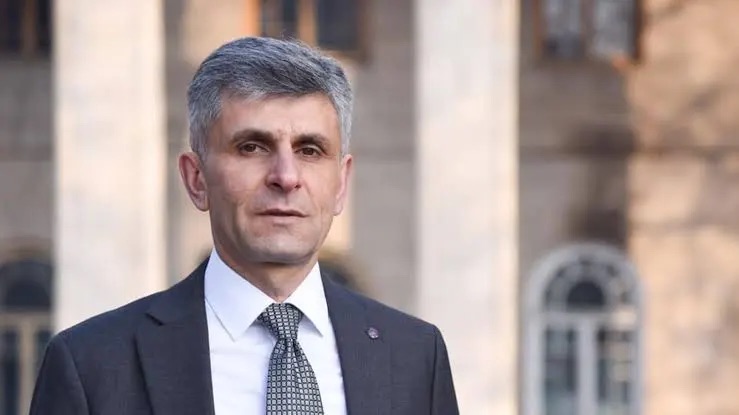
Here’s a more tightly trimmed intro, with the full statement left unchanged:
Davit Ishkhanyan has issued a new message from prison in Baku following the latest stage of proceedings against the former military and political leadership of Artsakh at the Baku Court of Appeal.
The Speaker of the National Assembly of the Republic of Artsakh says the verdict was predetermined long ago and that the defense has focused on completing the legal procedures necessary to take the case before international courts.
Ishkhanyan says the defense was repeatedly interrupted but succeeded in challenging what he describes as fabricated accusations, historical distortions, and attacks on Armenian national dignity. He argues that the proceedings have been governed by the law of force rather than the rule of law.
He also criticizes one-sided media coverage and the absence of international journalists from nearly two years of hearings. Ishkhanyan says the defense twice sought to have the prosecution terminated but was rejected and has still not received key court documents.
Concluding his message, Ishkhanyan declares: “We will have our say yet.”
The full text of the statement:
“The latest stage of the “peace trial” can now be considered complete. The Court of Appeal has retired to deliberate, but as we said in court, it is clear to all of us that the verdict was decided long ago. It is not the judicial panel that is making this decision. The panel will merely announce and publish what has already been decided.
Our closing statements were very strong and distinctive. As I have said before, they were worthy of the occasion. As in the Court of First Instance, both the prosecutors and the judge repeatedly intervened without justification and interrupted our speeches. Once again, I was not allowed to present my remarks in full. Nevertheless, that is not the issue. We all understand that this is a political trial, and we openly state that a political trial cannot be conducted any other way.
Perhaps the strongest assessment of these proceedings came from one of the defense lawyers, who warned the Court of First Instance that years from now they would be ashamed before their descendants. This time, he delivered a particularly powerful message to the judicial panel, urging them not to desecrate the court, saying that through this trial they had already desecrated their own victories. In other words, our collective conduct has already compelled them to acknowledge that they committed serious violations throughout these proceedings.
As I said in my closing statement before the Court of First Instance, politically and morally it is the prosecution and the judicial panel, who in reality act as the decision-makers in this case, that have lost the trial. We, the defendants, were the ones who prevailed.
We forcefully challenged the arguments and false claims directed against our people’s past and present, our people’s honor, the fabricated accusations, the conduct that tramples on our national dignity, and the falsification of history.
This is a battlefield governed by the law of force, not the force of law. The judges and the judicial panel are guided by the principle of “we are the ones who decide,” and they do whatever they wish. We understand that perfectly well.
But, as we have repeatedly said, that is secondary for us. We are completing all the necessary legal formalities so that we can take this case before the international courts. Therefore, this prosecution can be regarded as a failure.
As always, media coverage has been one-sided, manipulative, and detached from reality. Sometimes we even wonder: where are the journalists of Radio Free Europe/Radio Liberty, the journalists searching for freedom? We have been waiting for nearly two years to see them appear in the courtroom. After all, it is not difficult for them to report from the White House, the Kremlin, or the institutions of European countries, including Brussels. Yet we have never seen them in the courtrooms of Baku to show the world who is being tried, why they are being tried, and how they are being tried.
On July 17, I submitted a motion asking the court to require the prosecution, in light of the current circumstances, to withdraw the charges, terminate the criminal case, and end this criminal prosecution. The request was rejected immediately. Naturally, I pointed out that the junior prosecutors should consult with their superiors, but that request was also rejected on the spot.
On July 31, during our final hearing, in my closing statement I addressed the judge and made another proposal. I asked that, using the authority vested in the court, the substance of my motion be put forward for consideration, and that the judicial panel, if necessary, consult with those who are truly making the decisions, taking into account the delicate political situation between the two countries and the two peoples, as well as the role of external actors, and, as an investment in the future, terminate this criminal prosecution and close the case.
Whatever decision they make is another matter. Nevertheless, such a proposal has been made.
Once again, I must emphasize that throughout nearly two years of these two sets of proceedings, the defense has still not received the indictment, the prosecutorial conclusion, or the judgment of the Court of First Instance.
Stay well. We will have our say yet.”